What if you could learn trading without risking your money on day one?
The truth is, how to learn trading is less about making fast money and more about building the right skills step by step.
Trading can look hard when you first see charts, prices, and market news. But you do not need to know everything at once. You need a simple plan, regular practice, and patience.
At Daily Duniya, our website is your home for daily market updates, trading news, market analysis, and simple financial education. This guide will help you understand the basic steps you can follow to start your trading journey.
Start With the Trading Basics
The first step in learning how to trade is to understand what trading means. Trading is buying and selling an asset to try to make a profit when its price changes. An asset can be a stock, currency, or cryptocurrency.
Before you put money into the market, learn these basic ideas:
- What is a stock?
- What is forex?
- What is crypto?
- What is a trading chart?
- What makes prices go up or down?
- What is a buy and sell order?
You do not need to become an expert in one day. Spend some time learning one topic at a time. Good trading knowledge starts with simple concepts.
Learn How to Read a Trading Chart
Charts are one of the most important tools for traders. A chart shows how the price of an asset has moved over time. Learning to read a chart can help you understand market trends.
One common chart is called a candlestick chart. Each candle shows information about the price during a set time. It can show where the price opened, where it closed, and how high or low it moved.
You should slowly learn terms like:
- Trend: The general direction of price.
- Support: A price area where buying may become stronger.
- Resistance: A price area where selling may become stronger.
- Volume: The amount of an asset being traded.
Do not try to use ten indicators at once. Start with the basics and learn how price moves. Simple charts are often easier for beginners to understand.
Study the Market and Follow the News
Learning how to study trading also means learning why prices move. Prices can change because of company news, economic reports, interest rates, world events, and market sentiment. Market sentiment simply means how traders feel about the market.
This is why following reliable stock updates and trading news can be useful. For example, a major company announcement may affect its stock price. A big economic report can also move currency markets.
Make a daily learning habit. You can check:
- Major market news
- Important economic events
- Stock price movements
- Market trends
- Key company updates
But do not trade just because you see breaking news. First understand what happened and why it may matter. Good traders learn to think before they act.
Practice Before You Risk Real Money
One of the best answers to “how can I learn trading?” is practice. But you do not have to start with real money. Many trading platforms offer demo accounts where you can practice with virtual money.
A demo account lets you place trades without using your real cash. It can help you understand how orders work and how prices change. It also gives you a safe way to test your ideas.
Try keeping a simple trading journal. Write down:
- Why you entered a trade
- Where you planned to exit
- How much you wanted to risk
- What happened after the trade
- What you learned
Your goal at this stage is not to make fake money. Your goal is to build good habits. Practice can help you become more comfortable before you consider using real funds.
Learn Risk Management Before Profit
Many beginners focus only on how much money they can make. Smart learning starts with asking how much money you could lose.
Risk management means taking steps to control possible losses. One simple tool is a stop-loss, which is an order that can close a trade when the price reaches a level you choose.
Never trade money that you need for food, bills, school, or other important needs. Avoid using large amounts of borrowed money while you are still learning. A small loss can become much bigger when borrowing is involved.
Remember these simple rules:
- Protect your trading money.
- Avoid putting everything into one trade.
- Do not chase losses.
- Do not trade because of fear or excitement.
- Have a plan before entering a trade.
Trading is not a guaranteed way to make money. Even experienced traders have losing trades. Your first goal should be learning how to manage risk.
Build a Simple Trading Learning Plan
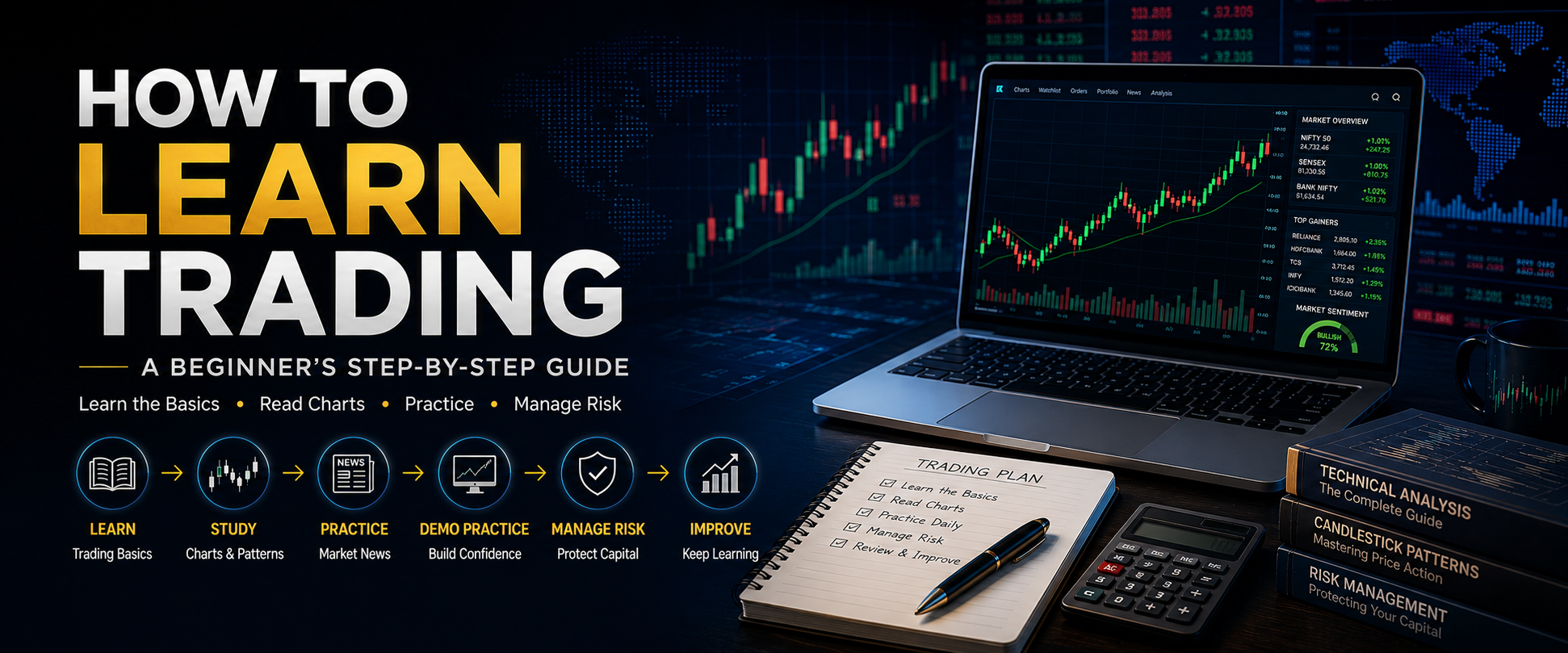
Now you know the main steps, it is time to create your own learning plan. You do not need to study for ten hours every day. Even 30 to 60 minutes of focused learning can help if you stay consistent.
Start with a simple weekly plan:
Day 1: Learn one trading concept.
Day 2: Study basic charts.
Day 3: Read market news and stock updates.
Day 4: Practice on a demo account.
Day 5: Review your practice trades.
Day 6: Study your mistakes.
Day 7: Rest or review what you learned.
You can also follow trusted market analysis to see how experienced people explain price movements. But do not copy every trade you see online. Use other opinions as learning material, not as a replacement for your own research.
For quick market tips, useful charts, and daily highlights, follow our Bull & Bear Whispers Instagram page. It can help you stay connected with important market information in a simple and easy format.
Keep Learning and Avoid Common Mistakes
Trading is a skill that takes time to develop. There is always something new to learn about markets, charts, risk, and trader behavior. The more you study, the better you can understand your own strengths and weaknesses.
Beginners often make the same mistakes. They enter trades without a plan, risk too much money, follow random tips, or expect quick profits. Some also trade more after a loss because they want to win the money back.
Avoid these habits. Focus on learning instead of trying to become rich quickly. Keep your strategy simple and review your results regularly.
Most importantly, remember that learning how to trade is a long-term process. You will make mistakes. The goal is to learn from them and improve.
Final Thoughts: Start Small, Learn Smart
So, how to learn trading the right way? Start with the basics, learn how charts work, follow market news, practice with a demo account, and understand risk before using real money.
Do not rush because someone online says they made quick profits. Do not believe that every trade will be successful. Build your knowledge slowly and make decisions based on a clear plan.
Trading can be challenging, but a strong learning process can make the journey easier. Stay patient, keep studying, and focus on improving one step at a time.
Want more simple trading content, exclusive updates, and real-time market alerts? Join the Bull & Bear Whispers WhatsApp channel for direct access to more content like this, exclusive updates, and important market alerts. Join our WhatsApp channel and keep learning with Daily Duniya.