Trading isn’t a one-size-fits-all activity. Different traders use different styles depending on their time, personality, and goals. Two of the most common approaches are day trading and swing trading. While both involve buying and selling financial instruments for profit, the biggest difference between them comes down to one thing: how long a trade is held.
Understanding this difference matters, especially for beginners, because it affects how much time you’ll need to spend watching the market, how fast decisions must be made, and how much risk you may be exposed to. This article breaks down day trading vs swing trading in simple terms, so you can understand how each works before deciding which approach fits you better.
For more simple trading and finance tips, follow Bull & Bear Whispers on Instagram.
What Is Day Trading?
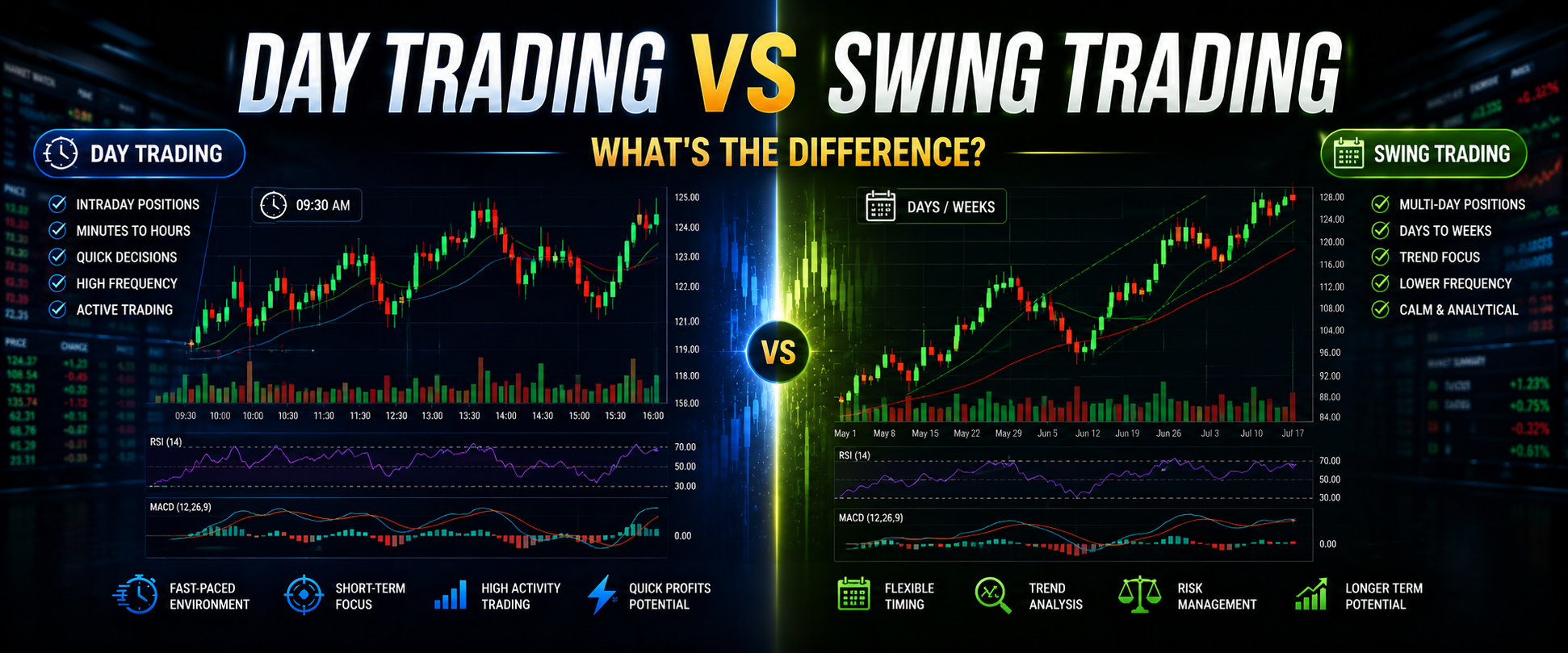
Day trading means opening and closing a trade within the same trading day. A day trader does not hold positions overnight every trade is started and finished before the market closes, regardless of whether it results in a profit or a loss.
Because trades are closed so quickly, day trading is built around short-term price movements. A day trader is usually watching charts for small, fast price changes that happen within minutes or hours, rather than trying to predict where a price will be next week or next month.
This style of trading generally requires a lot of market attention. Since decisions need to be made quickly, day traders often stay focused on live price charts for extended periods during market hours.
Example: A day trader buys a stock in the morning because the price is moving upward, then sells it a few hours later the same day to lock in the result, before the market closes.
What Is Swing Trading?
Swing trading takes a longer view. Instead of closing a trade the same day, a swing trader may hold a position for several days or even a few weeks. The goal is to capture a larger price movement a “swing” in price rather than reacting to small, minute-by-minute changes.
Because trades are held longer, swing trading generally requires less constant screen time than day trading. A swing trader might check charts once or twice a day rather than watching them continuously, which can make this style easier to fit around other commitments.
Example: A swing trader notices that a stock has been trending upward over several days and decides to hold their position for the following week, expecting the trend to continue before eventually closing the trade.
Day Trading vs Swing Trading: Key Differences
| Factor | Day Trading | Swing Trading |
| Holding time | Same trading day | Several days or weeks |
| Market monitoring | More frequent | Less frequent |
| Trading speed | Fast | Slower |
| Number of trades | Usually more | Usually fewer |
| Time commitment | Higher | Lower |
| Main focus | Short-term price moves | Larger price moves |
When comparing day trading vs swing trading, the core difference is really about time — how long a position is held and how much time the trader spends monitoring it. Day trading demands quick, frequent decisions throughout the day, while swing trading allows more room to analyze a setup before acting, since the trade isn’t expected to resolve within hours.
The difference between day trading and swing trading also shows up in the number of trades placed. Day traders often place multiple trades in a single session, while swing traders may only enter a handful of trades over the same period, since each one is given more time to develop.
Day Trading vs Swing Trading for Beginners
For someone just starting out, day trading vs swing trading for beginners often comes down to time and temperament rather than which one is “easier.”
Learning curve: Both styles require an understanding of price charts, but day trading’s fast pace means beginners often have less time to think before acting. Swing trading allows more time to study a setup before committing.
Time commitment: Day trading typically demands active attention during market hours. Swing trading fits better around a schedule that doesn’t allow constant monitoring.
Market monitoring: Day traders track price movements in near real time. Swing traders check in periodically rather than continuously.
Risk management: Both styles carry risk, and neither guarantees profit. Beginners in either style need a clear plan for how much they’re willing to risk on any single trade.
Emotional pressure: The fast decisions in day trading can create more emotional pressure in the moment. Swing trading’s slower pace can reduce some of that pressure, though watching an open position for days can bring its own stress.
Patience: Swing trading generally requires more patience, since a trade may take time to play out. Day trading requires patience of a different kind — the discipline to wait for the right setup rather than forcing trades.
Before trying either approach with real money, it helps to understand the fundamentals first. If you’re new to this altogether, our guide on What Is Trading? A Complete Beginner’s Guide is a good starting point.
Pros and Cons of Day Trading
Advantages of Day Trading
- Short holding periods mean trades are wrapped up the same day.
- No need to hold positions overnight, which avoids exposure to news or events that happen after the market closes.
- More short-term opportunities can arise throughout a single trading session.
Challenges of Day Trading
- Requires more sustained attention during market hours.
- Fast decisions leave little room for hesitation.
- The pace can create emotional pressure, especially for newer traders.
- Risk can increase quickly without proper risk management in place.
Because of these challenges, understanding risk management is essential before attempting day trading. Read more in our guide, What Is Risk Management in Trading and Why Does It Matter?
Pros and Cons of Swing Trading
Advantages of Swing Trading
- Less screen time is needed compared to day trading.
- More time to analyze a setup before entering or exiting a trade.
- The potential to target larger price movements over several days or weeks.
Challenges of Swing Trading
- Trades stay open longer, which means more time exposed to market movement.
- Overnight and weekend risk exists, since prices can shift while markets are closed.
- Patience is required, as a trade may take time to develop.
- Price can move against the trader while a position is still open.
Which Is Better: Day Trading or Swing Trading?
There’s no single answer to whether day trading or swing trading is “better” — it depends on the individual. A few factors worth considering:
- Available time: Can you dedicate hours to watching the market, or do you need a style that fits around other responsibilities?
- Experience: Are you comfortable making fast decisions, or do you prefer more time to think things through?
- Risk tolerance: How much short-term volatility are you comfortable with?
- Trading goals: Are you looking for frequent, smaller opportunities or fewer, larger ones?
- Ability to monitor the market: Day trading demands consistent attention; swing trading is more flexible.
- Personal trading style: Some people naturally prefer fast-paced decisions, while others prefer a slower, more analytical approach.
Whichever style you lean toward, the priority for beginners should be learning, practice, and risk management — not chasing guaranteed profits, because no trading style can promise those. If you’re still getting familiar with the basics, our guides on How Does Trading Work? A Simple Guide for Beginners and How to Start Trading for Beginners: A Step-by-Step Guide can help you build a foundation first.
How to Learn Day Trading and Swing Trading
If you’re interested in either approach, here’s a simple learning path to follow before risking real money:
- Learn trading basics — understand how markets, orders, and trades work.
- Understand technical analysis — learn how traders study price charts to make decisions. Our guide on What Is Technical Analysis in Trading? A Beginner’s Guide explains the fundamentals.
- Learn candlestick charts — these are one of the most common tools used to read price movement. See How to Read Candlestick Charts: A Beginner’s Guide for an introduction.
- Understand support and resistance — key price levels that traders watch closely, explained in Support and Resistance in Trading: A Beginner’s Guide.
- Learn risk management — protecting your capital is just as important as finding good trades.
- Practice before using real money — many traders use demo accounts to build experience without financial risk.
- Review trades and keep learning — recognizing patterns over time, including the ones covered in What Are Chart Patterns in Trading? A Beginner’s Guide can help sharpen decision-making.
According to Investopedia, both day trading and swing trading require a solid understanding of technical analysis and disciplined risk management, since neither style eliminates the possibility of loss.
Final Thoughts
When it comes to day trading vs swing trading, neither approach is inherently better; they simply suit different time commitments, risk tolerances, and personalities. Day trading offers fast-paced, short-term opportunities but demands close attention and quick decisions. Swing trading takes a slower approach, aiming for larger price moves with less constant monitoring, but still requires patience and careful risk management.
Before choosing either path, focus on learning the fundamentals, practicing without real money, and understanding your own risk tolerance. There are no shortcuts to guaranteed profits in either style, only informed, disciplined trading.
For more simple trading and finance updates, join the Bull & Bear Whispers WhatsApp Channel: Daily Duniya.