Money can grow when you learn how to use it. But trading is not a magic button that makes you rich overnight.
If you have ever asked, how does trading work, you are in the right place. Trading may look hard at first, but the basic idea is simple. You buy something at one price and try to sell it later at a better price.
At Daily Duniya, our home for money mindset, trading, and personal finance content, we break these ideas into simple lessons. Our goal is to help you understand money before you risk it.
What Is Trading?
Trading means buying and selling financial assets to try to make a profit. These assets can include stocks, currencies, gold, crypto, and other market products.
Think about a simple example. You buy a stock for $100. Later, its price goes to $110. If you sell it, your profit is $10, before fees and taxes.
But prices can also fall. If that same stock drops to $90 and you sell, you lose $10.
This is why trading is not just about making money. It is also about managing risk.
Trading for beginners starts with one simple rule: understand what you are buying before you buy it.
How Does Trading Work Step by Step?
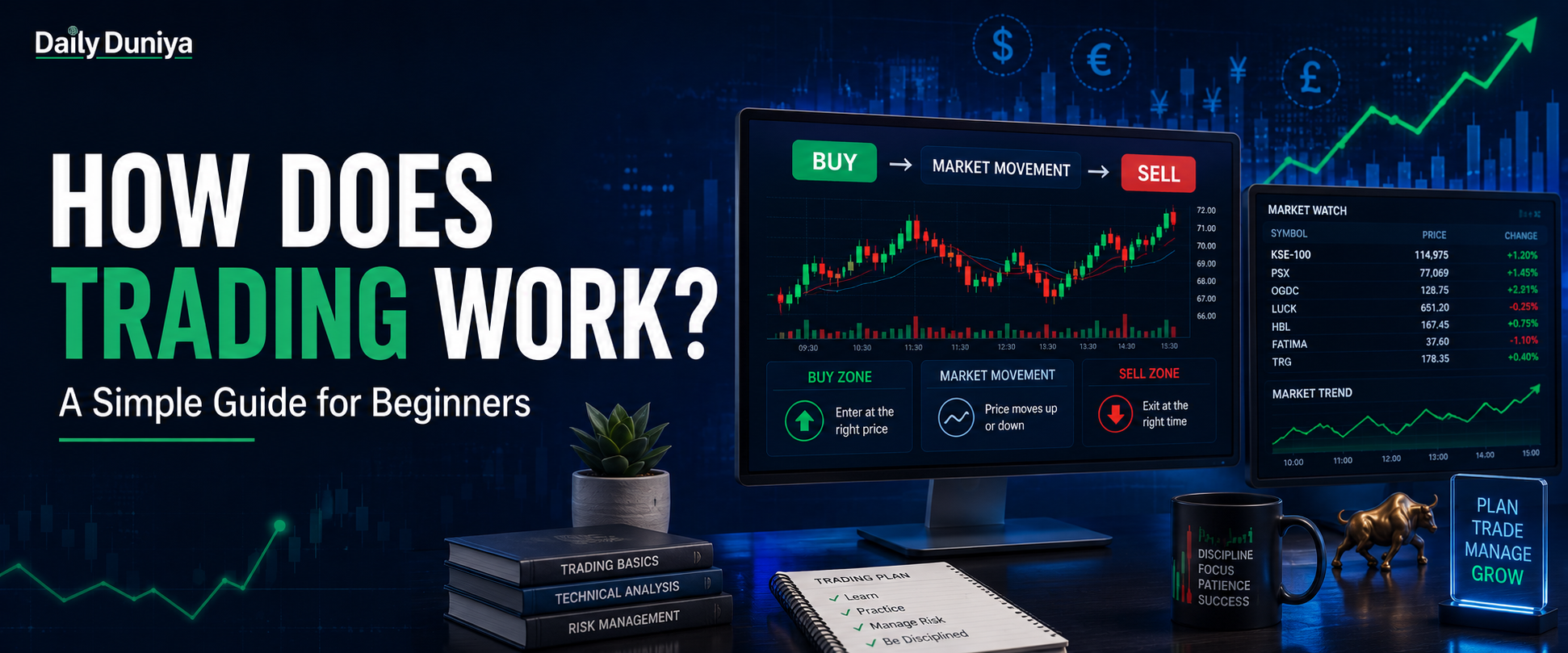
The trading process usually follows a few basic steps. You choose a market, study an asset, decide what you want to do, and place a trade through a trading platform or broker.
Here is the basic process:
- Choose a market: You may trade stocks, currencies, commodities, or other assets.
- Choose an asset: You select something you want to buy or sell.
- Do your research: You study its price, news, trends, and other useful information.
- Place an order: You tell your broker or platform what you want to buy or sell.
- Manage the trade: You watch the position and manage your risk.
- Close the trade: You sell or buy back the asset to finish the trade.
For example, imagine you think a company’s stock may rise. You buy 10 shares at $20 each. Your total position is $200.
If the price rises to $25, those shares are worth $250. If you sell them, your gain is $50 before costs.
That is the basic idea of how trading works.
Buying and Selling Stocks: The Basic Idea
One of the most common forms of trading is buying and selling stocks.
A stock represents a small part of a company. When you buy a stock, you become a small owner of that company.
Traders try to benefit from changes in stock prices. Some traders buy when they believe the price may rise. Some also use strategies that can benefit when prices fall, but these methods can carry extra risk.
The market price changes because buyers and sellers are constantly making decisions.
Prices can move because of:
- Company news
- Earnings reports
- Economic data
- Interest rates
- Political events
- Market sentiment
- Supply and demand
This is why prices can move quickly. A stock that looks strong in the morning may look very different later in the day.
You should never trade just because someone online says, “Buy this now.”
Learn first. Then decide.
Types of Trading You Should Know
There is not just one way to trade. Different traders use different time periods and strategies.
Day trading means opening and closing trades within the same day. Day traders often watch price movements closely and make many decisions.
Swing trading usually means holding a trade for several days or weeks. Traders try to benefit from larger price moves.
Position trading can last for weeks, months, or even longer. It usually focuses more on bigger market trends.
There is also forex trading, where people trade currencies such as the US dollar, euro, and British pound.
Other markets include commodities, indices, and cryptocurrencies.
As a beginner, you do not need to learn everything at once. Start with one market and understand it well.
The best trader is not always the person who trades the most. Sometimes, the smartest move is to wait.
Trading Is Not the Same as Gambling
This is an important point.
Some people treat trading like gambling. They enter trades without a plan and hope the price moves in their favor.
That is not a smart way to approach the market.
Good trading starts with a plan. You should know why you are entering a trade, how much you are willing to lose, and when you will leave.
Risk management is one of the most important parts of trading. Even a good strategy can have losing trades.
You may be wrong. That is normal.
The goal is not to win every trade. The goal is to protect your money and make better decisions over time.
A trader who controls losses has a better chance of staying in the game.
What Do Beginners Need to Start Trading?
You do not need a huge amount of money to start learning. In fact, your first goal should not be making big profits.
Your first goal should be learning.
Before you trade real money, learn these basics:
- How markets work
- How orders work
- How prices move
- How to read simple charts
- How to manage risk
- How trading fees work
- How emotions affect decisions
You also need a trading account with a suitable broker or platform. The right choice depends on your country, market, fees, regulations, and the assets you want to trade.
If you are in Pakistan, make sure you understand the rules that apply to the market and platform you plan to use.
You can also practice with a demo account. A demo account lets you learn the trading process without using real money.
That can help you build confidence before taking real risks.
Trading Psychology: Your Mind Matters
Here is something many beginners learn too late.
Trading is not only about charts.
It is also about your mind.
Fear can make you close a trade too early. Greed can make you hold a trade for too long. FOMO in trading can make you enter a trade because everyone else seems to be making money.
These emotions can lead to poor decisions.
Imagine you see a stock rising quickly. Everyone online is talking about it. You feel scared that you will miss the move, so you buy without research.
Then the price drops.
Now you panic and sell.
This cycle can repeat again and again.
A strong trading mindset helps you stay calm. You need patience, discipline, and a clear plan.
Remember this:
The market does not care about your emotions. Your job is to control them.
For more quick lessons, practical tips, short reels, and daily motivation about trading and money mindset, follow our bull&bearwhispers. We share simple ideas that can help you keep learning without feeling overwhelmed.
Common Beginner Trading Mistakes
Many new traders make the same mistakes. Learning about these mistakes can save you money and stress.
One common mistake is trading without a plan. If you do not know why you entered a trade, you may not know when to exit.
Another mistake is risking too much money on one trade. One bad trade should never destroy your account.
Some beginners also chase fast profits. They see someone showing a big win online and think they can make the same money quickly.
That mindset can be dangerous.
Other common mistakes include:
- Trading with borrowed money
- Following random signals
- Ignoring risk
- Making too many trades
- Trying to recover losses quickly
- Letting fear control decisions
- Believing every online “expert”
Do not compare your beginning with someone else’s highlight reel.
Trading is a skill. Skills take time to build.
Start Small, Learn More, Grow Smarter
Now you understand the basic answer to how does trading work.
You choose a market. You study an asset. You make a decision. You place a trade. You manage risk. Then you close the trade.
It sounds simple, but doing it well takes practice.
Do not enter the market because you want quick money. Enter only when you understand the risk and have a clear reason for your decision.
Start with education. Use a demo account if it suits you. Keep your risk small when you eventually use real money.
Most importantly, build your money mindset.
Your first win in trading is not making $1,000.
Your first win is making a smart decision.
Then another.
Then another.
Over time, those small improvements can make you a more disciplined and confident trader.
Trading is not about getting rich overnight. It is about learning how money moves, controlling your risk, and becoming better with every decision.
If you want more exclusive updates, deeper trading insights, money mindset lessons, and direct access to content like this, join our WhatsApp channel today: Join the bull&bearwhispers WhatsApp Channel
Learn before you trade. Control your risk. Master your mindset. Your financial journey starts with one smart decision.