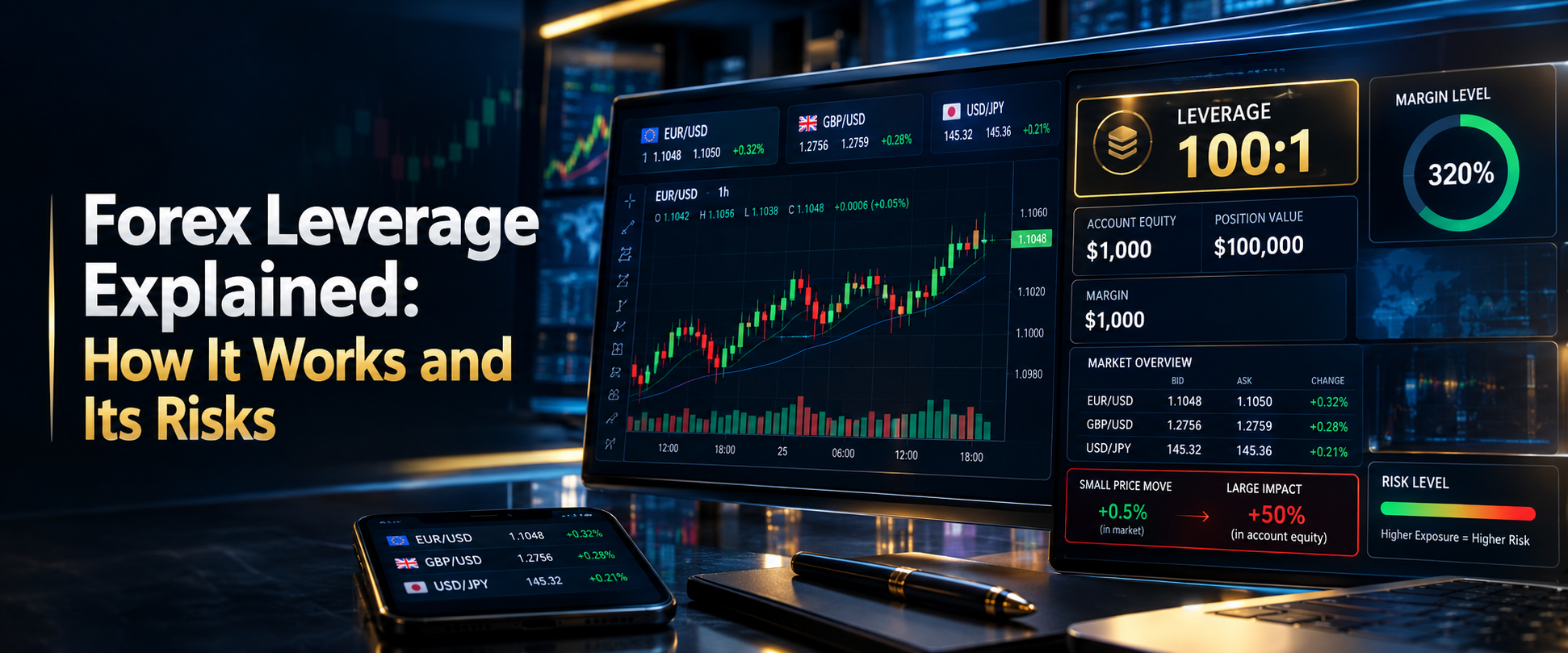
Forex leverage lets traders control a large position with a small amount of their own money. It can increase market exposure, but it also increases both potential profits and potential losses. At Daily Dunia, we explain forex leverage explained in simple language so you can see the full picture before trading.
Understanding how forex leverage works is essential. Leverage is a powerful tool, but without good risk control, it can lead to fast losses, margin calls, and stop outs.
How Does Forex Leverage Work?
Leverage works by letting you put down a small deposit (margin) to open a much larger trade. Your broker provides the rest of the funds needed for the full position size.
Simple hypothetical example:
- You have $1,000 in your account.
- Your broker offers 100:1 leverage.
- With 100:1, your $1,000 can control a position worth up to $100,000.
If the market moves 1% in your favor on a $100,000 position, that is a $1,000 gain—equal to 100% of your deposit. But if it moves 1% against you, that is a $1,000 loss—wiping out your entire deposit. This shows why forex leverage risks must be taken seriously.
Understanding Forex Leverage Ratios
Leverage is shown as a forex leverage ratio, such as 2:1, 10:1, 50:1, or 100:1. The ratio tells you how much exposure you get per unit of your own money.
- 2:1 – For every $1, you control $2.
- 10:1 – For every $1, you control $10.
- 50:1 – For every $1, you control $50.
- 100:1 – For every $1, you control $100.
Higher ratios mean larger positions for the same deposit, but they also mean each price move has a bigger impact on your account. This is a core part of leverage in forex that beginners often underestimate.
Leverage and Margin: What’s the Difference?
Leverage and margin are closely linked but not the same:
- Leverage is the multiplier that shows how much exposure you get.
- Margin is the actual amount of your money locked to open and hold a position.
They are two sides of the same coin:
- Higher leverage → lower margin required for the same position.
- Lower leverage → higher margin required for the same position.
For example, with 50:1 leverage (2% margin), a $100,000 position needs about $2,000 margin. With 100:1 (1% margin), the same position needs about $1,000 margin.
To learn more, see What Is Margin in Forex?.
Why Do Traders Use Forex Leverage?
Traders use leveraged trading in forex for a few main reasons:
- Increased market exposure: Control larger positions without tying up huge capital.
- Capital efficiency: Keep some funds free for other trades or as a buffer.
- Small moves, meaningful results: Forex pairs often move in small percentages; leverage can make those moves more significant relative to account size.
However, the same features that make leverage attractive also raise forex trading risk. Bigger exposure means bigger swings in equity, both up and down.
What Are the Risks of Forex Leverage?
The main forex leverage risks are:
- Magnified losses: Leverage increases the size of losses as well as gains. A small adverse move can cause a large percentage loss.
- Faster equity drops: High leverage can push your margin level down quickly, leading to warnings or forced closures.
- Emotional pressure: Large swings can lead to impulsive decisions, overtrading, or revenge trading.
This is why many regulators limit leverage for retail clients. For example, major pairs may be capped at 30:1 or 50:1 in some regions to reduce the chance of large, rapid losses.
How Leverage Can Affect Margin Calls and Stop Outs
Leverage directly influences the chance of a margin call or stop out. When you use high leverage:
- Required margin is smaller, so you can open larger positions.
- Each pip move changes your equity more, so your margin level can drop faster.
If losses grow and equity falls, your margin level may hit the broker’s warning threshold, triggering a margin call. If it falls further to the stop out level, the broker may automatically close positions.
For detailed explanations, see What Is a Margin Call in Forex? and What Is a Stop Out in Forex?.
How to Manage Leverage Risk
You can lower forex leverage risks with simple habits:
- Sensible position sizing: Use smaller lots so each move has less impact. See What Is Position Sizing in Trading?.
- Understand margin requirements: Know how much margin each trade uses and keep a buffer. See What Is Margin in Forex?.
- Avoid excessive leverage: Just because high leverage is available does not mean you must use it. Many experienced traders choose lower effective leverage.
- Use risk management: Define max risk per trade, use stop losses, and stick to your rules. See What Is Risk Management in Trading?.
- Monitor free margin: Keep enough free margin so small moves do not trigger warnings.
- Have a clear trading plan: Write down your rules for entries, exits, and risk. See How to Build a Trading Plan.
These steps do not remove risk, but they make it more manageable.
Common Forex Leverage Mistakes
Traders often make these mistakes with leverage in forex:
- Using maximum leverage by default: Assuming higher is better, without checking the impact on risk.
- Opening too many positions: Using most of the available margin and leaving little buffer.
- Ignoring stop losses: Letting losses grow until margin level becomes critical.
- Chasing losses with more leverage: Trying to “recover” by increasing size, which often makes things worse.
- Not understanding broker rules: Being surprised by margin call and stop out levels.
Avoiding these errors can help you stay in the game longer.
FAQs
What is forex leverage?
Forex leverage is a tool that lets traders control a larger position than their account balance by using borrowed funds from the broker, expressed as a ratio like 50:1 or 100:1.
How does forex leverage work?
Forex leverage works by requiring only a fraction of the full trade value as margin, allowing a small deposit to control a much larger notional position.
What are the risks of forex leverage?
The risks include magnified losses, faster drops in equity, and a higher chance of margin calls or stop outs if trades move against you.
Is higher leverage always better?
No. Higher leverage increases exposure and risk. Many traders choose lower effective leverage to keep risk under control.
How does leverage relate to margin calls and stop outs?
Higher leverage allows larger positions with less margin, so losses can reduce equity faster, pushing margin level down toward margin call and stop out thresholds.
For a trusted overview, see Investopedia’s explanation of leverage in forex.
Final Thoughts
Forex leverage explained simply means understanding that leverage is a multiplier: it increases both opportunity and risk. Used wisely, it can improve capital efficiency. Used poorly, it can lead to fast losses and forced closures. At Daily Dunia, we break down these concepts into clear, practical lessons so you can trade with more awareness. Follow our Instagram for quick forex insights, and join our WhatsApp Channel to get new articles and updates as soon as they are published.