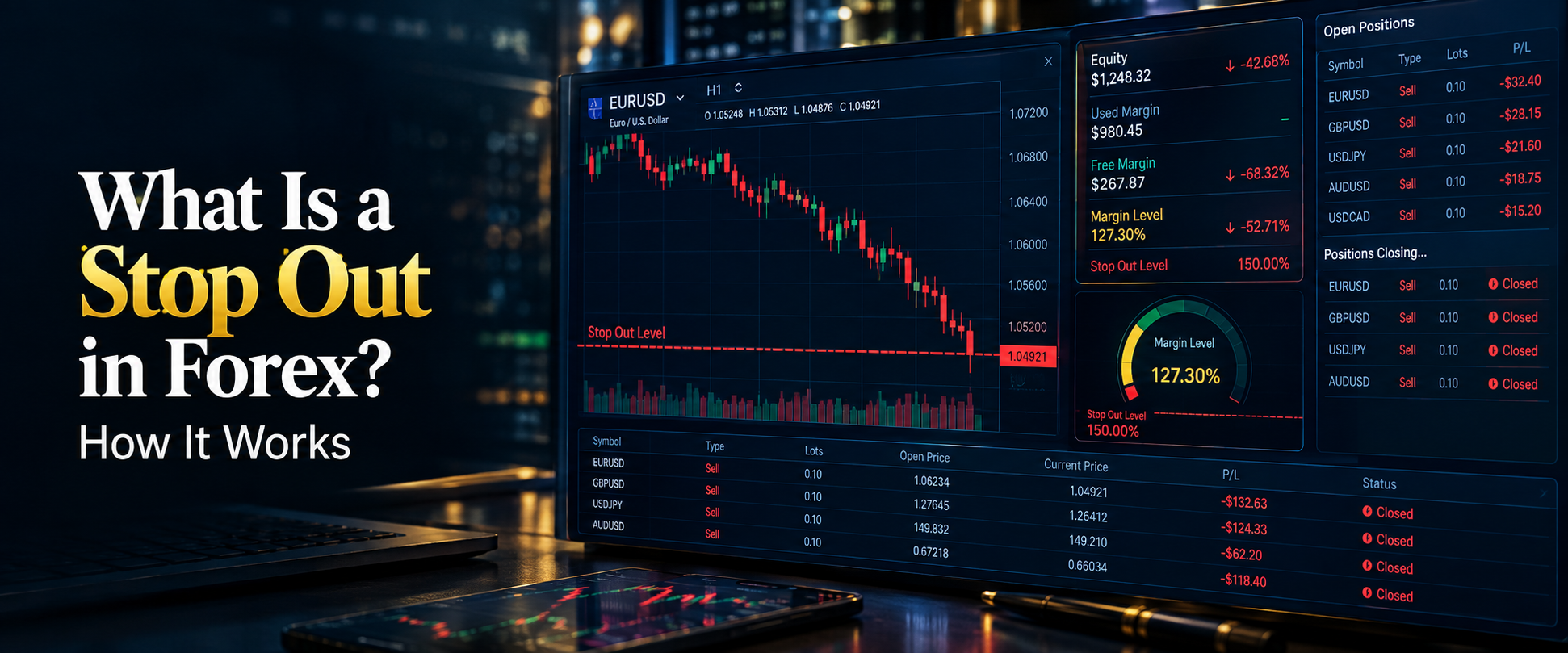
A stop out in forex is when your broker automatically closes your losing trades because your account no longer has enough funds to keep them open. It is a safety rule to stop losses from growing beyond your balance. At Daily Dunia, we explain this in very simple words so beginners can understand the risk before using leverage.
Understanding what is stop out is key for new traders. Leverage can make small moves feel big. If risk is not managed, a few bad trades can push your account to the stop out level and force closures. This article shows how it works and how to lower the risk.
What Is a Stop Out in Forex?
In simple stop out meaning, it is an automatic process where the broker starts closing your open positions when your forex margin level falls below a set limit. This limit is called the stop out level.
A forex stop out is not a choice you make at that moment. It is the broker’s last-resort action to protect your account from going into a negative balance.
How Does a Forex Stop Out Happen?
A stop out in forex usually follows these steps:
- You open leveraged trades. Part of your equity is locked as used margin.
- The market moves against you. Your open trades show unrealized losses.
- Your equity (balance + unrealized profit/loss) falls.
- Your forex margin level = (Equity ÷ Used margin) × 100 drops.
- When margin level hits the broker’s stop out level, the system starts closing positions automatically.
Brokers often close the most losing positions first to free up margin quickly.
What Is a Stop Out Level?
The stop out level is the margin level percentage at which automatic liquidation begins. It is set by the broker and can vary.
- Common range for many retail brokers: around 20% to 50% margin level.
- Some brokers may use different levels depending on regulation and account type.
Margin level formula:
Margin level % = (Equity ÷ Used margin) × 100
When this percentage falls to the stop out threshold, the forex stop out process starts.
Stop Out vs Margin Call
It is important to know the difference between margin call vs stop out:
- Margin call: A warning that your equity is low. You are asked to add funds or close trades. New trades may be blocked, but positions are not yet forcibly closed.
- Stop out: The next stage. If equity keeps falling, the broker automatically closes positions once the stop out level is reached.
Simple view:
Margin call = “Please act.”
Stop out = “We are acting for you.”
For more detail, see What Is a Margin Call in Forex?.
How Margin and Free Margin Affect Stop Out
Two concepts are central to forex trading risk:
- Used margin: Money locked to keep current trades open.
- Free margin in forex: Money left to open new trades or absorb losses.
Free margin = Equity − Used margin
When free margin shrinks toward zero, equity is mostly tied up in losing trades. This pushes forex margin level down. If it reaches the stop out level, the broker begins closing positions.
Monitoring free margin is a simple way to see how close you are to danger.
How Leverage Can Increase Stop Out Risk
Forex leverage lets you control large positions with a small deposit. But it also magnifies losses.
- Higher leverage → smaller required margin → larger position size.
- Larger position → each pip move changes equity more.
- Bigger equity swings → margin level can drop faster to the stop out level.
This is why understanding What Is Leverage in Trading? is essential before trading with real money.
Simple Forex Stop Out Example
Note: Numbers are hypothetical and for education only. Broker rules and levels can vary.
Imagine:
- Account balance: $1,000
- Used margin for open trades: $800
- Initial equity: $1,000 (no open loss yet)
- Initial margin level: (1,000 ÷ 800) × 100 = 125%
Now the market moves against you and open loss grows to $400.
- New equity = 1,000 − 400 = $600
- Used margin still around $800
- New margin level = (600 ÷ 800) × 100 = 75%
If your broker’s margin call level is 100%, you are already below it. You may be blocked from opening new trades.
If losses grow further and equity falls to $400:
- New margin level = (400 ÷ 800) × 100 = 50%
- If the broker’s stop out level is 50%, the system starts closing positions automatically.
The most losing position is usually closed first until margin level rises above the stop out threshold.
What Happens During a Stop Out?
During a stop out in forex:
- The broker’s system automatically closes some or all open positions.
- Closures usually start with the most losing trades to free margin fast.
- Trades are closed at current market prices, which can be worse during fast moves (slippage).
- The process continues until margin level is back above the stop out level or all positions are closed.
After a stop out, your account may have a much smaller balance, and you will need to rebuild carefully.
How to Reduce the Risk of a Stop Out
You cannot remove all risk, but you can lower the chance of a forex stop out:
- Use sensible position sizes: Smaller lots mean each move affects equity less. See What Is Position Sizing in Trading?.
- Understand leverage: Use lower leverage until you are experienced. See What Is Leverage in Trading?.
- Monitor free margin: Keep a buffer so equity does not hug used margin.
- Use risk management: Set stop losses and define max risk per trade. See What Is Risk Management in Trading?.
- Avoid overtrading: Too many open positions tie up margin and raise risk.
- Understand your broker’s margin rules: Know your stop out level and margin call rules.
For background on related concepts, see What Is Margin in Forex? and What Is a Stop Loss in Trading?.
Common Stop Out Mistakes Beginners Make
Beginners often make these mistakes around stop out in forex:
- Using very high leverage without understanding how fast equity can drop.
- Opening too many positions and using almost all free margin.
- Ignoring stop losses, so losses grow larger than planned.
- Adding more trades to “recover” losses, which increases used margin and risk.
- Not checking broker rules, so they are surprised by the stop out level.
Avoiding these errors can make your trading journey safer and more sustainable.
FAQs
What is a stop out in forex?
A stop out in forex is when a broker automatically closes a trader’s open positions because the account’s margin level has fallen below a set stop out level.
What causes a forex stop out?
A forex stop out is caused by losing trades that reduce equity, especially with high leverage or large position sizes, so margin level drops to the broker’s stop out threshold.
What is the difference between margin call and stop out?
A margin call is a warning to add funds or close trades; a stop out is the automatic closure of positions when margin level falls below a stricter limit.
Can traders avoid a stop out?
It cannot be guaranteed, but risk can be reduced with smaller positions, lower leverage, proper stop losses, and keeping enough free margin.
How does leverage affect stop out?
Higher leverage allows larger positions with less margin, so each price move has a bigger effect on equity, making stop outs more likely if trades move against you.
For a reliable overview, see Investopedia’s explanation of being stopped out.
Final Thoughts
A stop out in forex is a clear sign that risk has grown too high for the funds in the account. It shows why understanding margin, leverage, and position size is so important before trading with real money. At Daily Dunia, we break down these topics into simple, beginner‑friendly lessons so you can learn safely and confidently. Follow our Instagram for quick forex tips, and join our WhatsApp Channel to get new articles and updates as soon as they are published.