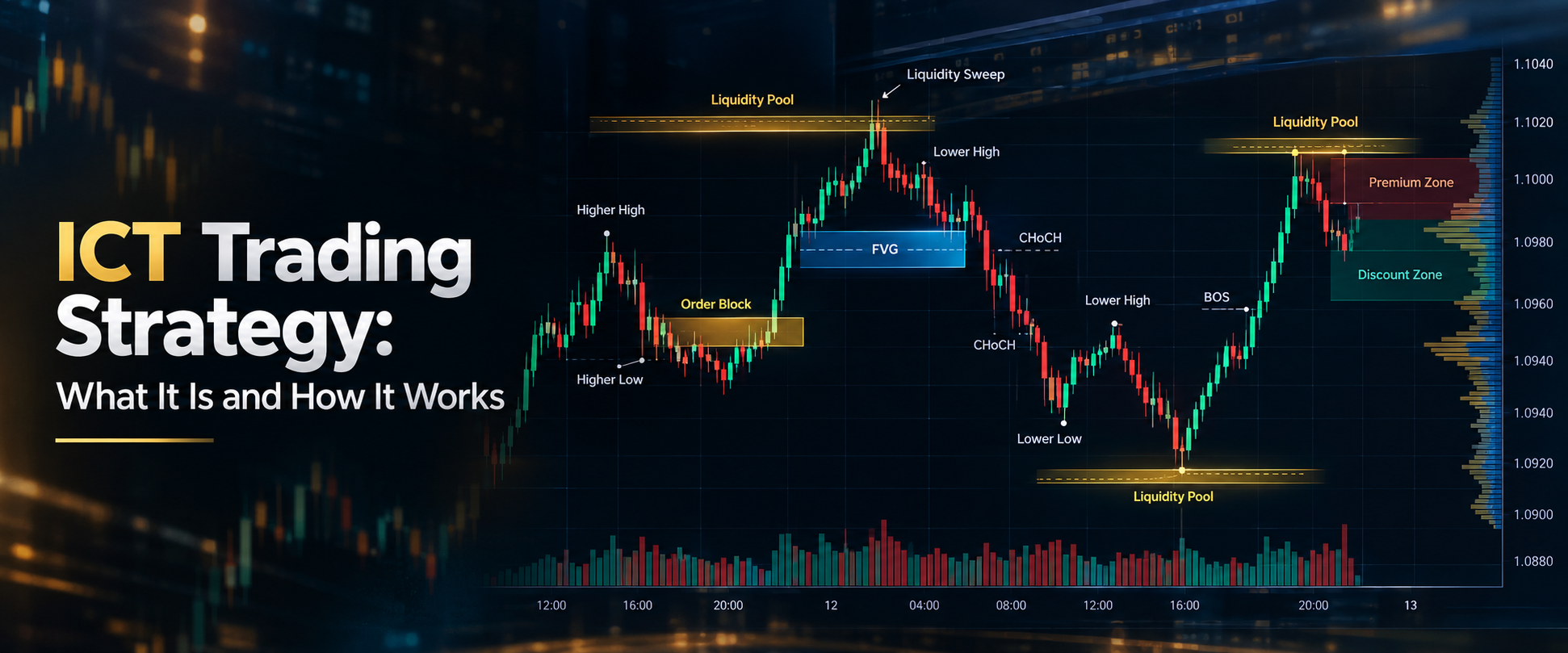
The ICT trading strategy refers to a set of price‑action concepts popularized by the Inner Circle Trader (ICT). It focuses on liquidity, market structure, and institutional‑style behavior to explain how price moves. At Daily Dunia, we explain ICT trading concepts in simple language so you can understand the methodology without hype or unrealistic claims.
This article covers what is ICT trading, how the ICT strategy works, and the main ideas behind ICT methodology, while making clear that it is not a guaranteed or superior system.
What Is ICT Trading?
ICT trading is a style of technical analysis built around the teachings of the Inner Circle Trader. It uses concepts like liquidity, market structure, Fair Value Gaps, and order blocks to interpret price action.
Instead of relying heavily on traditional indicators, ICT trading concepts emphasize where liquidity sits, how structure breaks, and where price may react based on past imbalances. It is one of many ways traders study charts.
How Does the ICT Trading Strategy Work?
The ICT trading strategy works by studying price movement through a few core ideas:
- Liquidity: Where stop losses and pending orders may cluster.
- Market structure: The sequence of higher highs, lower lows, and breaks in structure.
- Institutional‑style behavior: The idea that large participants move price to access liquidity and rebalance imbalances.
Traders using ICT concepts in trading look for areas where price might return to “fill” gaps, sweep liquidity, or react at key structural levels. None of these are guaranteed; they are analytical lenses.
Key ICT Trading Concepts
Beginners often encounter these ICT trading concepts:
- Liquidity: Pools of orders (often above highs or below lows) that price may target.
- Market structure: The pattern of swings (HH/HL or LH/LL) and breaks that show trend or reversal.
- Fair Value Gaps (FVG): Imbalance zones where price moved quickly, leaving a “gap” in value.
- Order Blocks: Specific candles or zones where strong moves began, watched as potential reaction areas.
- Break of Structure (BOS): When price breaks a prior significant high or low, suggesting trend continuation.
- Change of Character (CHoCH): An early sign that trend direction may be shifting.
- Premium and Discount: Viewing price as “expensive” (premium) or “cheap” (discount) relative to a range.
- Liquidity Sweeps: When price briefly moves beyond a level to trigger orders before reversing.
Each concept is a tool, not a standalone signal.
What Is Liquidity in ICT Trading?
In ICT trading, liquidity often refers to areas where many orders may sit, such as above prior highs or below prior lows. The idea is that prices may move toward these zones to “sweep” stops and fill orders.
- Buy‑side liquidity: Often above highs, where buy stops and breakout orders cluster.
- Sell‑side liquidity: Often below lows, where sell stops and breakdown orders cluster.
Liquidity concepts connect closely with real market mechanics. For background, see Liquidity in Trading and Market Depth in Trading.
What Is a Fair Value Gap?
A Fair Value Gap (FVG) is a three‑candle pattern where the middle candle moves so strongly that its wicks do not fully overlap with the neighboring candles. This leaves an imbalance zone that traders watch.
To identify an FVG:
- Look for a large directional candle.
- Check if the wicks of the candles before and after do not fully cover the middle candle’s body.
- The uncovered area is the FVG.
ICT traders may watch FVGs as potential areas where price could return to rebalance. However, not every FVG is filled, and none guarantee profitable trades.
What Are Order Blocks?
Order blocks in ICT are specific candles or zones where a strong move began. Traders mark these as areas of interest, expecting price might react if it returns there.
- A bullish order block is often the last down candle before a strong up move.
- A bearish order block is often the last up candle before a strong down move.
These are analytical concepts, not guaranteed reversal zones. Price can slice through them. Always combine with Risk Management in Trading and clear rules.
ICT Trading and Market Structure
ICT trading relies heavily on market structure:
- Higher highs and higher lows: Typical of an uptrend.
- Lower highs and lower lows: Typical of a downtrend.
- Break of Structure (BOS): When price breaks a key prior high/low, suggesting trend continuation.
- Change of Character (CHoCH): An early structural shift that may signal a potential reversal.
These ideas align with classic price‑action teaching. For a foundation, see Higher Highs and Lower Lows in Trading, Support and Resistance, and Breakouts in Trading.
ICT Trading vs Smart Money Concepts (SMC)
ICT trading and Smart Money Concepts (SMC) are closely related but not identical:
- ICT: A specific methodology from the Inner Circle Trader, with defined terms like FVG, order blocks, BOS, CHoCH.
- SMC: A broader umbrella that uses similar ideas (liquidity, structure, institutional behavior) but may mix sources and terminology.
Think of ICT as one branch within the wider SMC‑style thinking. Both focus on how large participants may influence price, but neither is a guaranteed edge.
Common ICT Trading Mistakes Beginners Make
Beginners often make these mistakes with ICT trading concepts:
- Learning too many concepts at once: Trying to use FVGs, order blocks, BOS, CHoCH, and liquidity all together from day one.
- Taking every liquidity sweep as a signal: Assuming every sweep leads to a reversal.
- Treating FVGs as guaranteed setups: Expecting every gap to be filled and traded profitably.
- Ignoring risk management: Entering without clear stops, position sizing, or risk limits. See Risk Management in Trading.
- Overcomplicating charts: Marking too many zones and losing clarity.
- Overtrading: Taking low‑quality setups just to be active.
- Following online signals blindly: Copying trades without understanding the logic or risk.
Avoiding these errors is as important as learning the concepts. For mindset, see Trading Psychology.
Is ICT Trading Suitable for Beginners?
ICT trading for beginners can be approached, but it requires patience. The concepts can take time to understand and apply consistently. Before using real money, it is wise to:
- Study the basics of What Is Technical Analysis in Trading?.
- Practice identifying structure, liquidity, and FVGs on historical charts.
- Build simple rules and test them with demo or historical data.
- Focus on risk management and journaling.
This article does not encourage immediate live trading. It encourages learning first.
FAQs
What is ICT trading?
ICT trading is a price‑action methodology based on concepts from the Inner Circle Trader, focusing on liquidity, market structure, FVGs, and order blocks.
What does ICT stand for in trading?
ICT stands for Inner Circle Trader, the source of this specific set of trading concepts.
What are the main ICT trading concepts?
Main concepts include liquidity, market structure, Fair Value Gaps, order blocks, Break of Structure, Change of Character, premium/discount, and liquidity sweeps.
Is ICT trading the same as Smart Money Concepts?
They are closely related but not exactly the same. ICT is a specific methodology; SMC is a broader approach using similar ideas.
Is ICT trading suitable for beginners?
Beginners can study ICT concepts, but they should focus on education, practice, and risk management before applying them with real money.
For a general reference on technical analysis, see Investopedia’s overview of technical analysis.
Final Thoughts
The ICT trading strategy offers a structured way to study price action through liquidity, market structure, and imbalance zones. It can help traders think about where price may react, but it is not a guaranteed or superior method. Success depends on understanding the concepts, applying sound risk management, and executing with discipline. At Daily Dunia, we explain trading ideas like ICT in a balanced, people‑first way. For short chart notes and updates, follow our Instagram, and for full articles, join the Daily Dunia WhatsApp Channel for new trading and finance content as soon as it is published.