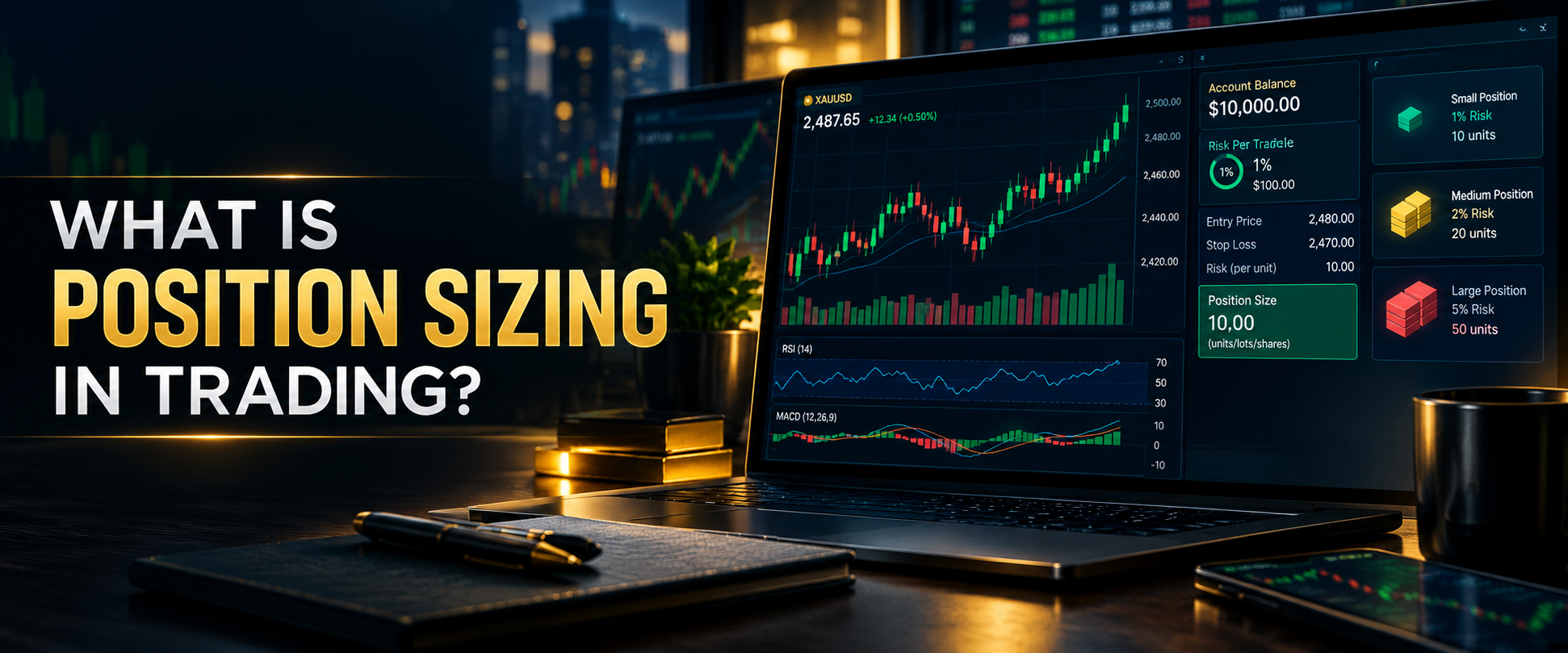
If you’re new to trading, you’ve probably heard the term “position sizing” and wondered what it means. It sounds technical, but it’s actually a simple idea.
Position sizing is one of the most important skills a trader can learn. It has nothing to do with picking the “right” stock or predicting where the market will go. It’s about deciding how much of an asset to trade at one time.
In this guide from Daily Dunia, we’ll explain position sizing in plain language, show you how to calculate it, and cover mistakes beginners often make. This article is for education only and is not financial advice.
What Is Position Sizing in Trading?
Position sizing means deciding how much of an asset — or how many units, shares, contracts, or lots a trader should buy or sell in a single trade.
Think of your trading account like a glass, and each trade like water you pour into it. You wouldn’t pour without checking the size of the glass first. Position sizing helps you figure out how much to pour into any one trade without overflowing.
Every trader has to answer one question before entering a trade: How much should I trade this time? That question is what position sizing answers.
Why Is Position Sizing Important?
Position sizing matters because it controls how much money you can lose on a single trade. No trade is guaranteed to work, even a well-researched one.
If a trader puts too much money into one trade, a single bad outcome can seriously damage their account. If a trader uses a sensible position size instead, one losing trade becomes a small, manageable event rather than a disaster.
This connects to the bigger picture of risk management in trading, which looks at protecting your capital across many trades, not just one. Position sizing helps traders:
- Avoid putting too much money into a single trade
- Keep losses small and manageable
- Stay in the game long enough to keep learning
How Does Position Sizing Work?
Position sizing connects four simple things: your account size, your risk per trade, your stop-loss distance, and the resulting position size.
Once you know the first three, you can work out an appropriate position size. Here’s a simple example: your account holds $1,000, and you’re comfortable risking 1% of it on one trade. That’s a maximum risk of $10. If your stop-loss sits $2 away from your entry price, your position size would be $10 divided by $2, which equals 5 units.
That’s the whole idea matching your trade size to the amount you’re willing to risk.
How to Calculate Position Size in Trading
Let’s walk through the math step by step, using the same easy numbers.
Step 1: Decide your account size. In our example, that’s $1,000.
Step 2: Decide your risk per trade. We’ll use 1% here.
Step 3: Work out your maximum dollar risk. $1,000 x 1% = $10.
Step 4: Identify your stop-loss distance. In our example, that’s $2.
Step 5: Calculate your position size. $10 ÷ $2 = 5 units.
So, in this example, the trader would take a position of 5 units. This is only meant to explain the math behind position sizing — not a suggestion to trade with real money. Real numbers will vary by market, asset, and account.
What Is Risk Per Trade?
Risk per trade is the amount of money, usually shown as a percentage of your account, that you’re willing to lose if a trade doesn’t work out.
Many traders risk only a small percentage of their account per trade instead of a large amount, because risking too much on one trade can be hard to recover from. There is no single percentage that’s correct for every trader. It depends on personal circumstances, experience, and comfort with uncertainty, so it’s worth thinking through your own number rather than copying one you saw online.
Position Sizing and Stop Loss
A stop loss in trading is an order that closes a trade automatically once price moves against you by a set amount. Position sizing and stop-loss distance are closely linked.
Say you want to risk a maximum of $10 on a trade:
- Stop-loss distance of $1 → position size of 10 units
- Stop-loss distance of $2 → position size of 5 units
- Stop-loss distance of $5 → position size of 2 units
As the stop-loss distance gets wider, the position size generally needs to shrink, as long as the maximum dollar risk stays the same. This keeps your risk consistent across different trades.
Position Sizing vs Lot Size: What’s the Difference?
Beginners often mix up “position size” and “lot size” because different markets use different words for similar ideas.
Position size is the general term for how much of an asset you’re trading, no matter the market. Units, shares, and contracts are the specific words used in different markets — stock traders say shares, futures and options traders say contracts.
Lot size is mostly used in forex trading, where a lot is a standardized amount of currency. Brokers often offer standard, mini, and micro lots, which are simply different sizes of the same idea. So position size is the overall concept, and lot size is one specific way of measuring it in forex. As Investopedia’s educational resources on trading explain, position size is directly tied to how much capital is being put at risk in a given trade.
Common Position Sizing Mistakes Beginners Make
- Taking positions that are too large, often out of excitement about a trade idea
- Ignoring stop-loss distance when choosing how much to trade
- Risking too much on one trade, which can be costly if it fails
- Increasing position size after a loss, in an attempt to win it back quickly
- Copying another trader’s position size, even though account sizes and risk tolerance differ
- Trading without a risk plan, which leads to inconsistent results
- Using leverage without understanding the risk it adds to position size
How Position Sizing Helps Control Trading Emotions
Trading isn’t only about numbers, it’s also about managing emotions, which is a core part of trading psychology.
When a position is too large, every small price move can feel stressful. This can fuel fear, greed, FOMO, overtrading, or revenge trading, where a trader jumps into another trade too quickly to make up for a loss. Our guide on how to avoid overtrading covers this in more detail.
A smaller, well-planned position can make it easier to stick to a trading plan and think clearly, giving a trade room to develop without every tick feeling urgent. It doesn’t remove trading risk, but it can support more disciplined decisions. For more on this, see our guide on how to build a strong trading mindset.
If you enjoy simple, beginner-friendly trading content like this, you can also follow Daily Dunia on Bull & Bear Whispers for more educational posts.
How to Use Position Sizing in a Trading Plan
A trading plan is a written set of rules that guides your decisions, and position sizing is a key piece of it, alongside entry rules, exit rules, and maximum risk levels.
A basic plan might include the maximum percentage of your account you’re willing to risk per trade, how you’ll calculate position size before entering, where your stop loss will sit, and clear entry and exit rules. Our guide on how to build a trading plan walks through this in more depth, and if a trade doesn’t go your way, how to stay calm during a losing trade can help you respond calmly rather than emotionally.
Final Thoughts
Position sizing might seem like a small technical detail, but it’s one of the foundations of disciplined trading. It connects your account size, your risk tolerance, and your stop-loss distance into one simple decision: how much should I trade this time?
Understanding position sizing won’t guarantee profits or remove risk from trading. What it can do is help you approach each trade with a clearer plan and a more consistent approach to risk something especially valuable for beginners still finding their footing.
Stay updated with more beginner-friendly trading guides. Follow the Bull & Bear Whispers WhatsApp Channel for new articles: Join here.