After a big fall, prices sometimes rise for a short time before falling again. Traders call this brief, misleading recovery a dead cat bounce, and it catches many beginners who think the worst is over. If you have watched a falling stock or coin suddenly jump and wondered what is a dead cat bounce, this Daily Dunia guide explains what a dead cat bounce is, why it happens, and how beginners can tell it apart from a real recovery.
We will also look at the warning signs and how traders manage risk when they are not sure which one they are seeing.
What Is a Dead Cat Bounce?
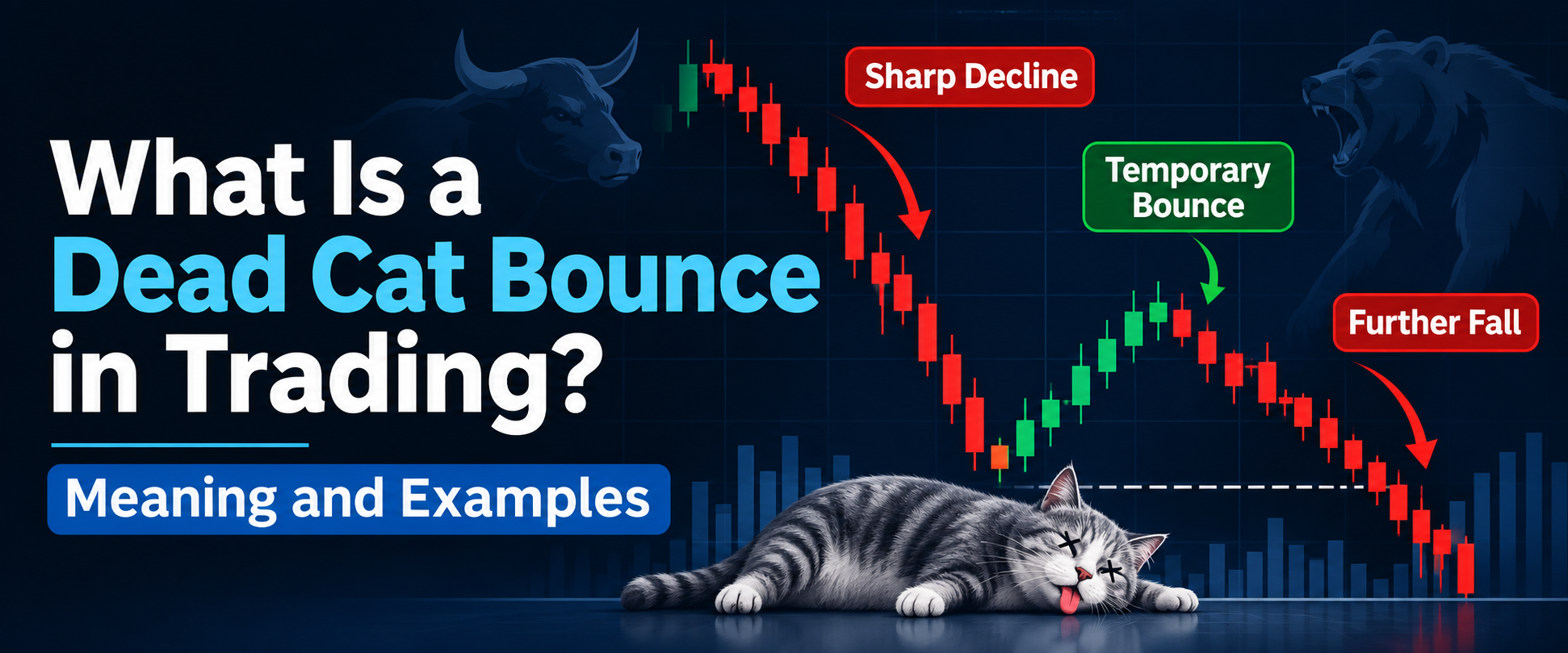
A dead cat bounce is a short, temporary rise in price during a larger downtrend, followed by a continuation of the decline. The bounce can look like the start of a recovery, but it usually fades, and price often falls to new lows afterward.
That is the basic dead cat bounce meaning. The key idea is that the bigger trend has not changed. The bounce is a pause, sometimes called a relief rally, not a turnaround.
A dead cat bounce in stocks is common after bad earnings, weak guidance or a market-wide sell-off. It can also appear in forex, commodities and crypto.
Why Is It Called a Dead Cat Bounce?
The name comes from an old Wall Street saying: “Even a dead cat will bounce if it falls from a great height.” The phrase is dark humor, not a literal description. It simply means that even something that has fallen hard can rebound a little before falling again. The term became popular in financial news in the 1980s and is now widely used by traders.
How Does a Dead Cat Bounce Happen?
A dead cat bounce happens when a sharp fall is followed by a brief rally that fails to change the bigger downtrend.
Step-by-Step Example
Hypothetical example: a stock falls from $100 to $60 after disappointing results, a drop of 40%. A few days later, it bounces to $70, a gain of about 16.7% from the low. Some traders believe the recovery has started and buy the dip. But the rally fades, and price slides again to $50, a new low.
| Stage | Price | What Traders Feel |
|---|---|---|
| Sharp Fall | $100 → $60 | Fear and panic |
| Bounce | $60 → $70 | Relief |
| Hope | Stalls near $70 | Belief that the worst is over |
| Decline Continues | $70 → $50 | Shock and regret |
A buyer at $70 who holds until $50 is down $20 per share, which is about 28.6% of the purchase price.
Why Dead Cat Bounces Form
Dead cat bounces usually form for one or more of these reasons:
- Short covering: short sellers buy back shares to take profits, which pushes price up for a while.
- Bargain hunting: some buyers see a lower price as a discount and step in.
- Oversold conditions: after a fast drop, selling pressure often pauses before it resumes.
- Temporary good news: a positive headline can spark a short rally without fixing the deeper problem.
Recognizing the dead cat bounce pattern takes practice, because the first part of a bounce looks exactly like the start of a recovery.
Dead Cat Bounce vs Real Trend Reversal
The difference between a dead cat bounce and a real trend reversal is usually clear only after some time. In the moment, both start with price rising after a fall, and a dead cat bounce can usually be confirmed only once the decline continues.
In the dead cat bounce vs reversal comparison, the key is what happens next. A false recovery runs out of buyers and rolls over, while a real reversal builds strength and holds its gains.
| Feature | Dead Cat Bounce | Real Reversal |
|---|---|---|
| Volume | Often low or fading on the bounce | Often rising as buyers return |
| Market Structure | Lower highs and lower lows continue | Higher highs and higher lows begin to form |
| Duration | Short, often days to a few weeks | Longer, with gains holding over time |
| Fundamentals | The bad news or weak results remain | The underlying problem improves |
| Follow-Through | Price falls back and often makes a new low | Pullbacks hold above the previous low |
A real reversal usually shows a shift from lower highs and lower lows to higher highs and higher lows. Learning to read higher highs and lower lows makes this change much easier to spot.
Signs of a Dead Cat Bounce
There are several signs of a dead cat bounce to watch for. If you are learning how to identify a dead cat bounce, look for these clues together, not one at a time.
Weak Volume on the Bounce
If price rises but trading volume stays weak, few buyers are committed. Strong recoveries usually need strong participation.
Price Fails at a Previous Support Level (Now Resistance)
When support breaks, it often becomes resistance. Dead cat bounces frequently rally back to that old support level and stall there as sellers return.
The Bigger Downtrend Is Still Intact
If the bounce peaks below the last swing high and the next drop breaks the recent low, the downtrend is still in place. Understanding trend continuation helps you see when a bounce is just a pause in a larger move.
No Change in the Bad News or Fundamentals
If the reason for the original fall, such as weak earnings or falling demand, is still there, a quick rally is less likely to last.
How Traders Handle a Dead Cat Bounce
Most careful traders handle a dead cat bounce by waiting for confirmation instead of reacting to the first rally. Here is how to trade a dead cat bounce, or rather how to approach one safely:
- Avoid rushing to buy the dip. A falling price is not automatically a bargain. Wait for confirmation before buying.
- Wait for structure to change. Treat a bounce as a recovery only after price forms a higher low and breaks above a recent swing high.
- Expect higher volatility. After big falls, both bounces and drops can be sharp and fast. Learn more about volatility in trading before you trade these moves.
- Use small positions and clear stop-losses. Decide your exit before you enter, and keep your size small enough that being wrong only costs a little. Good risk management matters more than guessing the outcome.
Some experienced traders look for short opportunities near the end of a bounce. This carries high risk, because a short position loses money if the bounce turns into a real recovery, and it is not suitable for beginners.
No method can always identify a dead cat bounce in advance, so focus on managing risk rather than predicting the outcome.
Frequently Asked Questions
What is a dead cat bounce in simple words?
It is a short price rise after a big fall that does not last. The price soon drops again, often to a new low.
How long does a dead cat bounce last?
There is no fixed length. It can last a few hours, a few days or a few weeks, depending on the market and the time frame.
Can a dead cat bounce happen in crypto and forex?
Yes. A dead cat bounce in crypto is often faster and sharper than in stocks because crypto trades around the clock and is very volatile. It can also happen in forex after a currency falls sharply.
How do I know if a bounce is real?
You usually cannot know for sure at first. Rising volume, higher highs and higher lows, and improving fundamentals are signs of a real recovery, but confirmation often takes time.
Final Thoughts
So, what is a dead cat bounce? It is a short-lived recovery inside a bigger downtrend, followed by more selling. Not every bounce is a recovery, and a dead cat bounce can usually be confirmed only after the decline continues. Watching volume, market structure and the news behind the fall can help, but patience, confirmation and risk management help beginners avoid the most costly mistakes. Practice reading these moves on a demo account first.
To keep learning how markets move in simple words, explore more beginner guides on Daily Dunia.