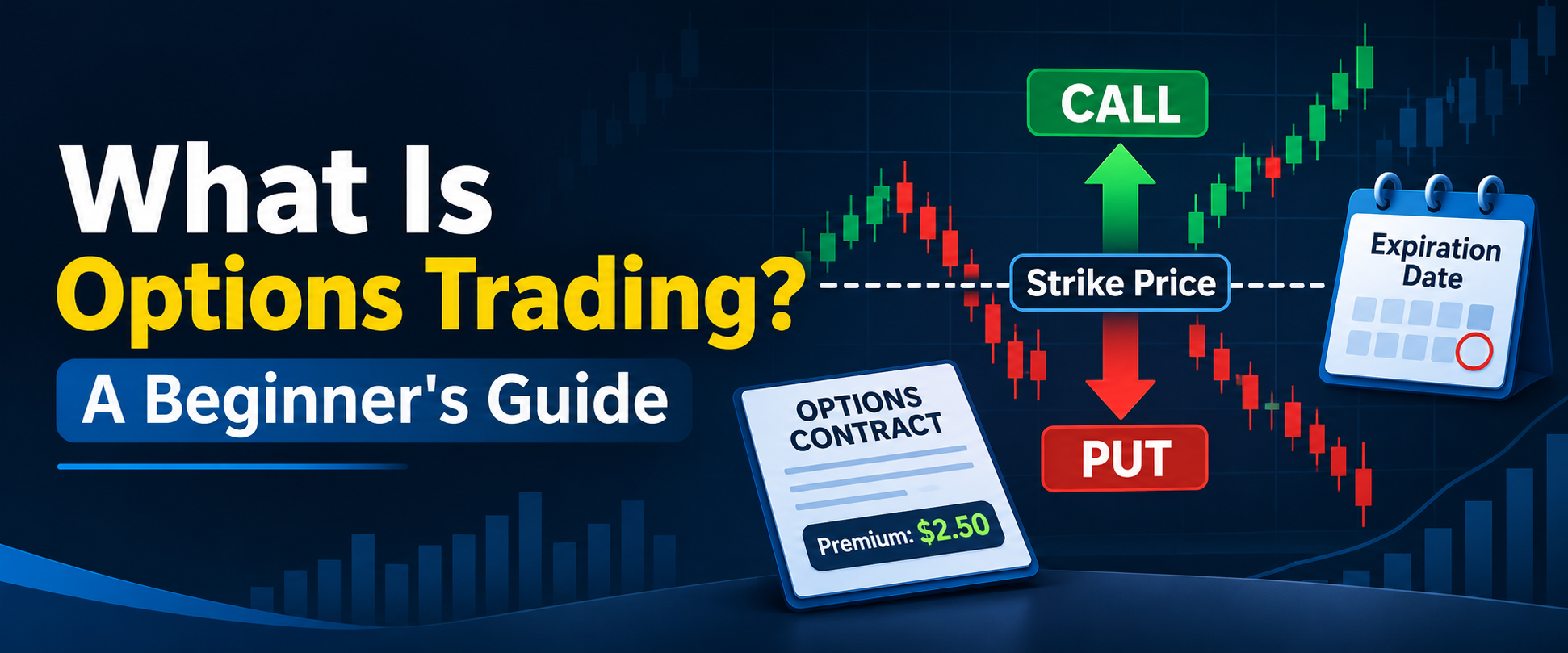
Options let traders bet on where a price might go, or protect an existing position, without buying the shares directly. Because they cost less upfront than the shares themselves, options can magnify both gains and losses. If you have been wondering what is options trading and whether it is worth learning, this Daily Dunia guide explains what options trading is, how call and put options work, and the key risks every beginner should understand.
We will keep it simple, with step-by-step examples and an honest look at the risks.
What Is Options Trading?
Options trading is the buying and selling of contracts that give you the right, but not the obligation, to buy or sell an asset at a set price on or before a set date. Traders use these contracts to speculate on price moves or to protect other investments.
An options contract is a type of derivative, which means its value comes from another asset, such as a stock or an index.
The key word is “right.” As an option buyer, you choose whether to use the contract. If using it would not make sense, you can simply let it expire.
Key Options Trading Terms Beginners Must Know
These five terms form the basis of stock options explained in simple words.
Underlying Asset
The underlying asset is what the option is based on, such as a stock, an ETF or an index. When the underlying asset’s price moves, the option’s value changes too.
Strike Price
So, what is a strike price? It is the fixed price at which the option lets you buy or sell the underlying asset. Whether the strike sits above or below the current price decides if an option is in the money, at the money or out of the money.
Expiration Date
The expiration date is the last day the option is valid. After that, the contract expires and any right it gave you ends.
Option Premium
What is an option premium? It is the price you pay to buy an option. The premium is made up of intrinsic value, which is any real value right now, and time value, which reflects the chance of a move before expiration.
Contract Size
One standard US stock option contract usually represents 100 shares. So a premium quoted as $2 per share costs $2 × 100 = $200 per contract. Contract specifications can differ in other markets.
What Is a Call Option?
A call option gives the buyer the right to buy the underlying asset at the strike price before or on the expiration date. Traders buy calls when they expect the price to rise.
Here is a hypothetical example. A stock trades at $50. You buy one call option with a $55 strike for a $2 premium per share.
- Cost of the call: $2 × 100 shares = $200.
- Break-even price: $55 strike + $2 premium = $57.
If the stock rises to $62 by expiration:
- Value of the option: ($62 − $55) × 100 = $700.
- Profit: $700 − $200 premium = $500.
That is a 250% return on the 200premium(500 ÷ $200), which shows how leverage works with options.
If the stock stays below $55: the option expires worthless, and you lose the full $200 premium.
All figures are hypothetical and exclude fees.
What Is a Put Option?
A put option gives the buyer the right to sell the underlying asset at the strike price before or on the expiration date. Traders buy puts when they expect the price to fall, or to protect shares they already own.
Here is a hypothetical example. A stock trades at $50. You buy one put option with a $45 strike for a $2 premium per share.
- Cost of the put: $2 × 100 shares = $200.
- Break-even price: $45 strike − $2 premium = $43.
If the stock falls to $38 by expiration:
- Value of the option: ($45 − $38) × 100 = $700.
- Profit: $700 − $200 premium = $500.
If the stock stays above $45: the option expires worthless, and you lose the full $200 premium.
If you already owned 100 shares, the same put would work like insurance. Below $45, gains on the put would help offset losses on your shares.
All figures are hypothetical and exclude fees.
Call vs Put Options
The main difference between call and put options is direction. A call profits when the price rises above the strike, while a put profits when the price falls below it. For buyers, the maximum loss in both cases is the premium paid.
| Feature | Call Option | Put Option |
|---|---|---|
| Right Given | To buy at the strike price | To sell at the strike price |
| Market View | Bullish (expect a rise) | Bearish (expect a fall) |
| Profits When | Price rises above strike + premium | Price falls below strike − premium |
| Maximum Loss (Buyer) | The premium paid | The premium paid |
| Common Use | Speculating on a rise | Speculating on a fall or hedging shares |
How Does Options Trading Work?
Here is how options trading works: every contract has two sides, a buyer and a seller, also called the option writer.
The buyer pays the premium and gets the right to exercise the option. The seller receives the premium but takes on the obligation to buy or sell if the option is exercised, which is called assignment.
Sellers can face large losses, and selling uncovered calls carries theoretically unlimited risk, because a stock’s price has no upper limit.
Options also give leverage. A small premium controls 100 shares, so a small price move can create a big percentage gain or loss. Learn more about leverage in trading before you start.
Traders also watch open interest, which shows how many option contracts are still open. Higher open interest usually means a more active, easier-to-trade contract.
Why Do Traders Use Options?
Traders use options for three main reasons:
- Speculation: betting on a price rise or fall with a smaller upfront cost than buying shares.
- Hedging: buying puts to protect stocks you already own against a drop, much like insurance.
- Generating income: some experienced investors sell options to collect premiums. This is an advanced strategy with its own serious risks.
Risks of Options Trading
Is options trading risky? Yes, especially for beginners. The main risks include:
- Options can expire worthless: if the price does not move enough in time, buyers lose the full premium.
- Time decay: an option’s time value shrinks as expiration gets closer, even if the price does not move.
- High volatility: option prices can swing sharply, and changes in implied volatility can affect the premium.
- Complexity: pricing depends on several factors at once, which makes options harder to understand than shares.
- Large losses for sellers: option writers can lose far more than the premium they receive.
Strong risk management is essential. Many brokers also require you to apply for options approval before you can trade options in your brokerage account.
Frequently Asked Questions
What is options trading in simple words?
Options trading means buying or selling contracts that give the right to buy or sell an asset at a fixed price before a set date. You can profit from price moves without owning the asset.
Is options trading good for beginners?
Usually not as a starting point. Options are complex and many expire worthless, so beginners should first learn the basics and practice with paper trading. Most guides on options trading for beginners suggest learning to buy options before ever selling them, because a buyer’s loss is limited to the premium.
Can you lose more than you invest in options?
If you buy options, the most you can lose is the premium paid. If you sell options, losses can be much larger, and selling uncovered calls has theoretically unlimited risk.
What is the difference between options and stocks?
A stock gives you part ownership of a company with no expiry date. An option is a time-limited contract based on a stock’s price, and it can lose all its value at expiration.
Final Thoughts
So, what is options trading? It is the use of flexible contracts to speculate on price moves or protect existing positions. Options can be powerful, but they are complex and risky, with time decay and expiration working against buyers. Learn how the stock market works first, then practice with paper trading before risking real money.
To keep learning trading and investing concepts in simple words, explore more beginner guides on Daily Dunia.