Traders use price, volume, and other market data to understand what is happening in a market. Open interest in trading is one such measure, especially in futures and options. At Daily Dunia, we explain what it counts, how it differs from trading volume, and why it is best treated as context—not a stand-alone signal.
What Is Open Interest in Trading?
Open interest is the number of derivative contracts that remain open at a particular point in time. These are contracts that have not been closed, settled, expired, or otherwise ended. It is commonly reported for futures and options.
A futures or options contract has both a buyer and a seller. Open interest counts the contract once—not once for each person on either side. It measures outstanding contracts, not the number of traders or completed transactions.
For example, if one buyer and one seller create a new futures contract, open interest rises by one. If they later close that contract, open interest falls by one.
How Does Open Interest Work?
Open interest changes according to whether the two sides of a transaction are opening or closing positions:
- Both sides open new positions: Open interest increases.
- Both sides close existing positions: Open interest decreases.
- One side opens while the other closes: Open interest stays the same; the contract has changed hands but remains open.
Every contract has a long side and a short side. So rising open interest means more contracts are outstanding; it does not mean there are more buyers than sellers.
Open Interest vs Trading Volume
Open interest and volume are related, but they measure different things. Volume counts how many contracts traded during a selected period. Open interest counts how many contracts remain open at a point in time.
| Measure | What it counts | When it changes |
| Trading volume | Contracts traded during a period | Whenever a contract is traded |
| Open interest | Outstanding contracts still open | When contracts are opened or closed |
Illustrative example: Suppose 100 futures contracts are traded today. Some may be new contracts, and others may be existing positions changing hands or being closed. Volume for the day is 100, but open interest might rise by only 20, fall, or stay unchanged, depending on how many contracts were opened and closed.
For a separate explanation of activity, read What Is Trading Volume?.
How to Read Price and Open Interest Together
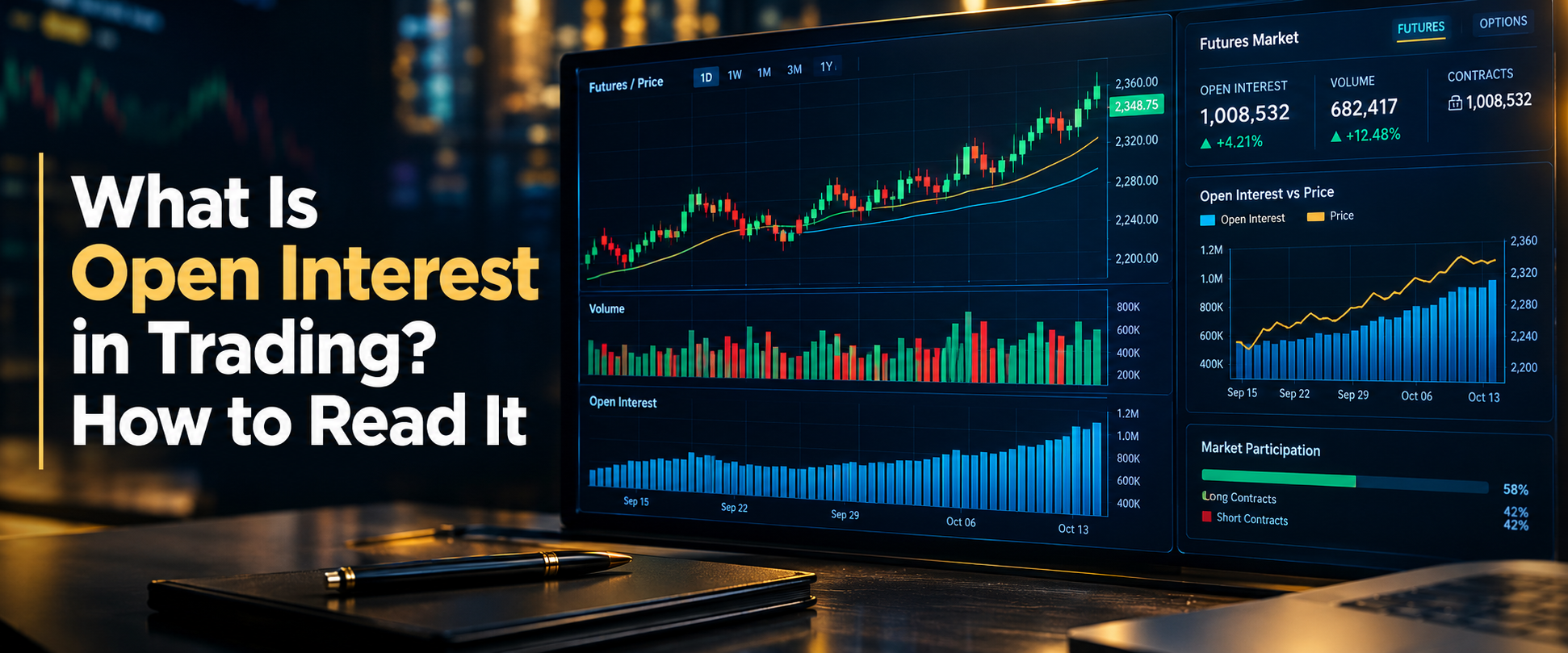
Traders often compare price and open interest to add context to a move. These combinations can offer clues about participation, but they do not reveal every trader’s position or predict what price will do next.
- Price rises and open interest rises: More contracts are being added while price rises. Some analysts interpret this as increased participation alongside the rise.
- Price rises and open interest falls: Contracts are being closed overall as price rises. The move may involve position closing, but the data alone cannot confirm the reason.
- Price falls and open interest rises: More contracts are being added while price falls. This can show increased participation during the decline.
- Price falls and open interest falls: Contracts are being closed overall as price falls.
These are broad ways to describe the data, not automatic bullish or bearish signals. Open interest does not identify whether new positions are long or short, and every open contract has both sides. Interpret it with price action, volume, contract details, and other market information.
Why Do Traders Watch Open Interest?
Traders may use open interest analysis to:
- Track whether the number of outstanding contracts is growing or shrinking.
- Add context to price and volume analysis.
- Compare participation across contracts or expiration periods.
- Study activity in futures and options markets.
Open interest is only one data point. It does not show the identity, motives, or exact expectations of market participants. It can also be reported at a different time from live price and volume data, depending on the market. Check the data source and reporting period before drawing conclusions.
For related context, see Daily Dunia’s articles on liquidity in trading and market depth in trading. Liquidity and market depth are not the same as open interest, but they can help describe different aspects of market activity.
Open Interest in Futures vs Options
Open interest applies to both futures and options. For futures, it is the number of contracts still outstanding for a contract or delivery month.
In options, open interest can be listed separately for each contract series, including its strike price and expiration date. A strike price is the price at which the option can be exercised under its terms; the expiration date is when the option ends. As a result, one option may have high open interest while another option on the same underlying asset has little.
High open interest does not automatically mean a contract can be traded at a favourable price. Check other information—such as bid-ask spreads and trading activity—rather than assuming open interest alone tells you how easy it is to trade. The Options Industry Council explains that open interest reflects contracts still open, not whether a market view is bullish.
Common Mistakes When Using Open Interest
Avoid these common misunderstandings:
- Treating rising open interest as automatically bullish. It counts open contracts, not net buying pressure.
- Confusing open interest with volume. One measures outstanding contracts; the other measures transactions during a period.
- Ignoring price behaviour and other information. Open interest alone gives an incomplete picture.
- Assuming it reveals who is trading or why. The figure does not identify participants or their intentions.
- Using data without checking the market and reporting time. Futures and options data may refer to specific contracts or reporting periods.
A sound approach is to understand what the number measures before interpreting a change.
Simple Open Interest Example
The following numbers are illustrative:
- Two traders enter a new futures contract, one as buyer and one as seller. Open interest increases by 1.
- Another pair of traders creates two new contracts. Open interest increases by 2, so it is now 3.
- A trader takes over an existing contract from someone who is closing their position. The contract remains open, so open interest stays at 3.
- The parties to one open contract later close it. Open interest falls from 3 to 2.
Volume records the trading activity that occurred in these steps. Open interest records how many contracts remain open afterward.
Frequently Asked Questions
What does open interest mean in trading?
It is the number of futures or options contracts that remain open and have not been closed, settled, expired, or otherwise terminated.
Is open interest the same as trading volume?
No. Volume counts contracts traded during a period; open interest counts outstanding contracts at a point in time.
Is rising open interest bullish or bearish?
Neither by itself. Rising open interest means outstanding contracts increased. Price movement and other market information are needed for context, and even then the data does not guarantee direction.
Where can traders find open interest data?
It may be available from futures exchanges, options data providers, and trading platforms. Availability and update timing differ by market and provider.
Can open interest predict market direction?
No. It can add information about outstanding contracts, but it cannot reliably predict price direction on its own.
For a recognised educational source, see the Options Industry Council’s explanation of open interest.
Conclusion
Open interest in trading measures contracts that remain open; volume measures contracts traded during a period. Comparing open interest with price and volume can add context, but it cannot reveal every participant’s intent or reliably predict direction. At Daily Dunia, we encourage readers to use market data carefully and as one part of a broader analysis. Follow our Instagram for a short explainer on open interest versus volume, and join the Daily Dunia WhatsApp Channel for more trading education and market updates.