If you have ever placed an order on a trading platform, you may have noticed a small window showing rows of numbers, prices, and quantities. That window is called market depth. It shows how many buy and sell orders are waiting at different price levels for a stock, currency, or crypto asset.
Understanding market depth in trading helps you see what is really happening behind a price chart. It is one of the most useful tools for anyone who wants to understand how prices move and how orders get filled.
In this guide from Daily Dunia, we will explain market depth in very simple language, with real examples, so you can start reading it with confidence.
What Is Market Depth in Trading?
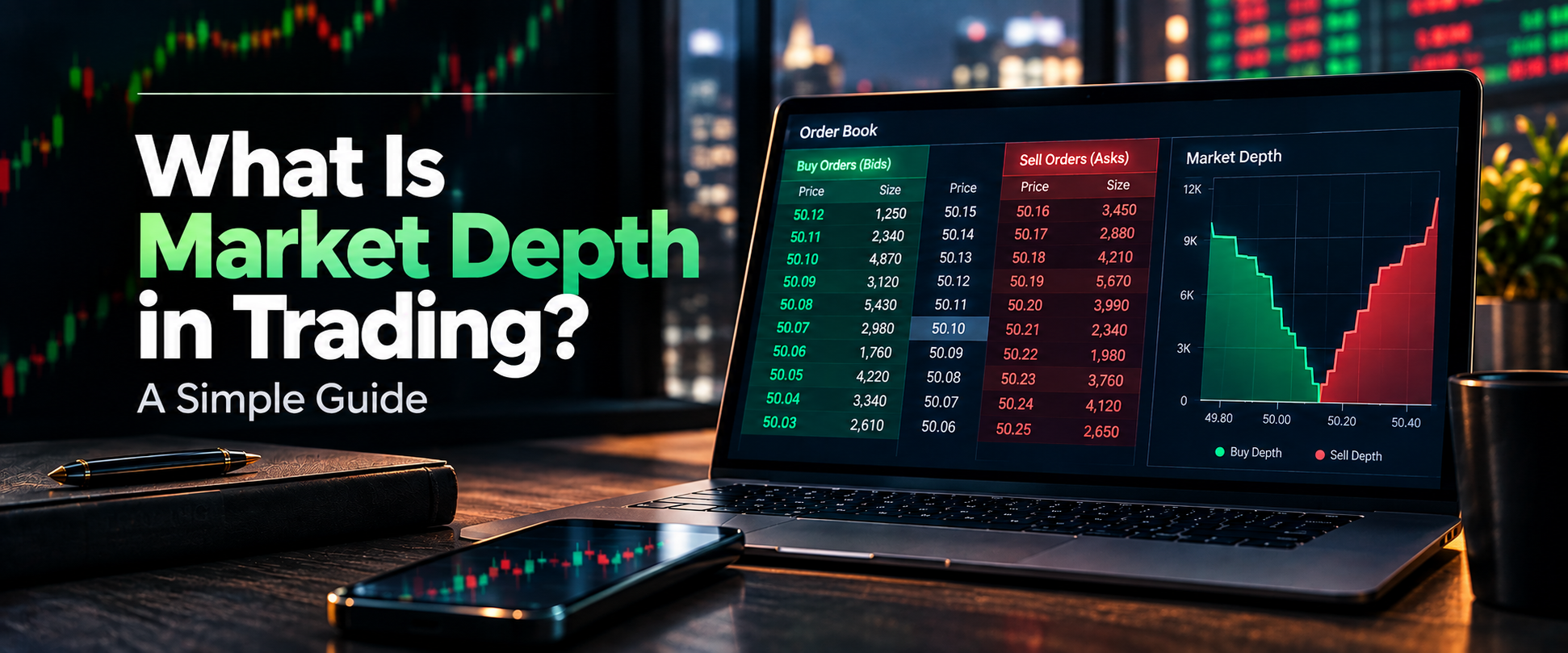
Market depth is a live list of buy and sell orders for a specific asset, organized by price level. It shows how many shares or units traders want to buy or sell at each price, above and below the current market price.
Think of it like a queue at a ticket counter. Some people are waiting to buy tickets at a lower price, and some sellers are willing to sell at a higher price. Market depth shows you the whole queue, not just the person at the front.
A market with strong depth has many orders at many price levels. A market with weak depth has very few orders, which means prices can jump around more easily.
How Does Market Depth Work?
Every time a trader places an order that is not filled immediately, it goes into a queue. This queue is visible in the market depth window.
There are two main types of orders that build market depth:
- Buy orders (bids): Traders who want to buy at a certain price.
- Sell orders (asks): Traders who want to sell at a certain price.
As new orders come in, or old orders get filled or cancelled, the market depth window updates in real time. This gives traders a live snapshot of supply and demand.
Market depth does not tell you what will happen next. It only shows the orders that currently exist. Prices can still move against what the depth suggests, especially when big, unexpected orders arrive.
What Is an Order Book?
The order book is the full record of all buy and sell orders for an asset. Market depth is simply the visual, organized version of this order book.
An order book usually has two sides:
- The bid side, listing buyer orders from the highest price down.
- The ask side, listing seller orders from the lowest price up.
The gap between the highest bid and the lowest ask is called the spread. A smaller spread usually means the market is more active and easier to trade in.
Most trading platforms display the order book depth as a simple table or as a visual chart with colored bars.
What Are Bid and Ask Orders?
Bid and ask orders are the building blocks of market depth.
- A bid is the price a buyer is willing to pay for an asset.
- An ask is the price a seller is willing to accept.
For example, if a stock’s highest bid is $50.00 and its lowest ask is $50.05, that five-cent difference is the spread. When a trade happens, it is because a buyer accepted the seller’s ask price, or a seller accepted the buyer’s bid price.
Large amounts of buy and sell orders sitting near the current price usually mean the market can handle bigger trades without big price jumps.
How to Read Market Depth
Reading a market depth chart becomes easier once you understand its basic layout.
- Price column: Shows different price levels.
- Bid size: Shows how much quantity buyers want at each price.
- Ask size: Shows how much quantity sellers want at each price.
- Cumulative totals: Some platforms add up the orders so you can see total demand or supply up to a certain price.
Many platforms use a visual bar chart, often called a depth chart, where the buy side and sell side are shown in different colors. A steep, thick wall of orders at one price level is sometimes called a “wall,” and it can act like a temporary barrier to price movement, though it is never a guarantee.
Market Depth vs Trading Volume: What’s the Difference?
People often confuse market depth with trading volume, but they measure different things.
Market depth shows orders that are waiting to be filled, at this moment, at different prices. Trading volume, on the other hand, shows how many units have already been bought and sold over a certain period, like a day or an hour.
In simple words, depth is about what could happen next, while volume is about what has already happened. If you want a deeper explanation of how volume is calculated and why it matters, Daily Dunia has a full guide: What Is Trading Volume? A Beginner’s Guide to Volume in Trading.
Market Depth vs Liquidity: What’s the Difference?
Market depth and liquidity are closely related, but they are not the same thing.
Liquidity describes how easily an asset can be bought or sold without causing a big price change. Market depth is one of the tools used to measure liquidity, because it shows how many orders exist at different price levels.
A market with deep order books at many price levels is usually more liquid. A market with thin order books, where only a few orders exist, is usually less liquid and can be more volatile.
To understand liquidity in more detail, you can read Daily Dunia’s article: Liquidity in Trading: What It Means and Why It Matters.
Why Does Market Depth Matter to Traders?
Market depth matters because it gives traders extra context beyond just the current price.
It can help traders:
- See how much buying or selling pressure exists nearby.
- Estimate how easily a large order might get filled.
- Spot possible support and resistance zones based on order clusters.
- Understand short-term supply and demand better.
However, it is important to remember that market depth reflects only the orders that are currently visible. It does not predict future price direction, and large traders can add or cancel orders quickly, which changes the picture.
How Market Depth Can Affect Order Execution
When you place a trade, market depth can directly affect how your order gets filled.
If there is strong depth near the current price, a market order is more likely to be filled close to the price you expected. If depth is thin, your order might get filled at a much different price than expected. This difference is known as slippage.
For a closer look at this topic, check out Daily Dunia’s guide: What Is Slippage in Trading? A Beginner’s Guide.
Traders who plan to place large orders often study market depth first, so they can avoid moving the price too much. This is closely connected to position sizing, which you can learn more about in Daily Dunia’s article: What Is Position Sizing in Trading? A Beginner’s Guide.
Common Market Depth Mistakes Beginners Make
New traders sometimes misread or misuse market depth. Some common mistakes include:
- Assuming depth predicts price direction. Depth shows current orders, not future outcomes.
- Ignoring that large orders can be cancelled anytime. A big wall of orders can disappear in seconds.
- Trading only based on depth, without a plan. Depth should support your strategy, not replace it.
- Overlooking risk management. No matter how depth looks, protecting your capital always comes first. Daily Dunia’s guide, What Is Risk Management in Trading and Why Does It Matter?, explains this in detail.
Avoiding these mistakes can help you use market depth as a helpful tool rather than a shortcut.
By the way, if you enjoy simple, practical explanations like this one, you can also follow Bull & Bear Whispers on Instagram for quick trading tips and updates in an easy-to-understand format.
Final Thoughts
Market depth in trading is a simple but powerful concept. It shows the buy and sell orders waiting at different price levels, giving traders a clearer view of supply and demand.
Market depth works closely with liquidity, trading volume, and order execution. Together, these concepts help traders understand not just where a price is, but how strong or weak that price level really is.
Remember, market depth can provide useful information about available buy and sell orders, but it does not guarantee where the price will move next. Markets can change quickly, and depth is only one piece of the puzzle.
As always, this article is for educational purposes only and is not financial advice. Always do your own research, and consider your personal risk tolerance before trading.
For more simple trading guides like this one, join the Bull & Bear Whispers WhatsApp Channel to get new articles as soon as they are published.