Many people want to learn trading because financial markets are more accessible than ever. You can study stocks, forex, cryptocurrencies, and commodities from a phone or laptop. However, easy access does not mean trading is easy.
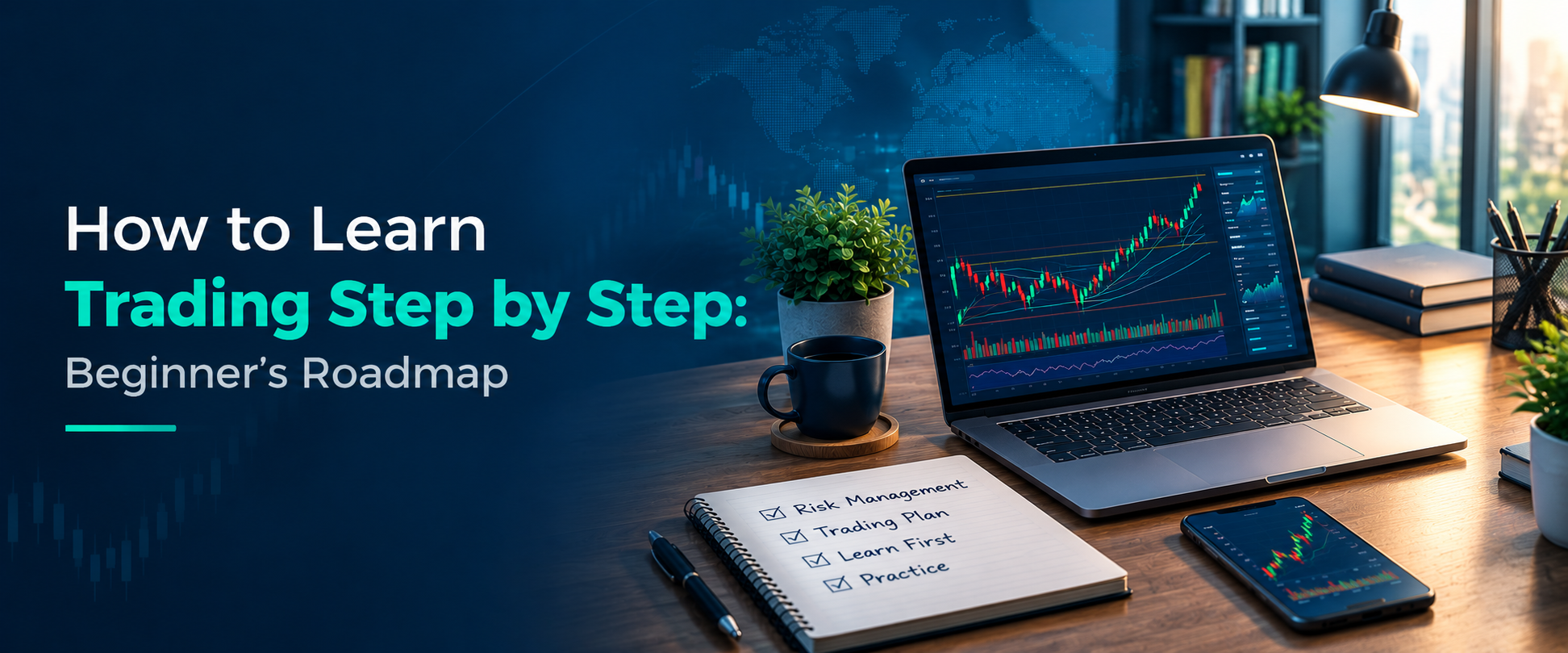
The right approach is to learn first, practise carefully, and manage risk before putting real money into the market. This guide explains how to learn trading step by step, so you can build useful knowledge instead of relying on random tips, signals, or social-media hype.
What Is Trading and Why Should You Learn It?
Trading is the buying and selling of financial assets with the aim of benefiting from price movements. A trader may buy an asset if they believe its price could rise, or sell it where the market and trading method allow if they expect the price to fall.
The assets traders commonly study include:
- Stocks of public companies
- Currency pairs in the forex market
- Cryptocurrencies such as Bitcoin
- Commodities such as gold, oil, or silver
- Indices that track groups of stocks
To understand the concept in more detail, read Daily Dunia’s guide on What Is Trading?.
Trading and investing are related but different. Investing usually focuses on holding assets for the long term, often for years. Trading generally involves making decisions over shorter timeframes, from minutes to months. Before choosing either approach, it helps to understand Trading vs Investing.
Learning about markets can improve your financial awareness. Still, trading should never be treated as a guaranteed income source. It requires preparation, discipline, and an understanding of risk.
How Long Does It Take to Learn Trading?
There is no fixed time limit for learning trading. Some people understand the basics within a few weeks, while building the ability to follow a strategy consistently can take months or longer.
Your progress depends on several factors:
- How regularly you study
- Whether you practise with a demo account
- How well you understand risk management
- Whether you review your mistakes
- Whether you focus on one market and one simple method at first
Do not expect quick results. The first goal should be to understand how markets work, not to make fast profits. A structured learning process is more valuable than trying to copy someone else’s trades.
Step 1: Understand Trading Basics
The first step in how to learn trading is understanding the basic language and structure of the market. You do not need to memorise every advanced term immediately, but you should know the essentials.
A market is a place where buyers and sellers exchange assets. In modern trading, this often happens through online platforms and brokers. Prices move because of supply and demand. If buying interest increases, prices may rise. If more traders want to sell, prices may fall.
Important trading terms include:
- Long position: Buying an asset because you expect its price to rise
- Short position: Taking a position that may benefit if an asset’s price falls
- Bid price: The highest price a buyer is willing to pay
- Ask price: The lowest price a seller is willing to accept
- Spread: The difference between the bid and ask price
- Liquidity: How easily an asset can be bought or sold
- Volatility: How strongly and quickly prices move
Start with Daily Dunia’s Trading Basics Explained article if you want a clearer foundation before moving to charts and strategies.
Step 2: Learn How Financial Markets Work
Before you choose a market, understand what you are trading and why prices move. Each market has different hours, risks, regulations, and levels of volatility.
Stock Market
Stocks represent ownership in a company. Their prices can move because of company earnings, business news, economic data, interest rates, and market sentiment.
People who want to learn stock trading should begin with large, liquid stocks and understand how orders, trading sessions, and company news can affect prices.
Forex Market
Forex, or foreign exchange, involves trading one currency against another. Examples include EUR/USD, GBP/USD, and USD/JPY.
The forex market is active during weekdays and is influenced by central-bank decisions, inflation data, employment reports, and global events. Currency pairs can move quickly, so risk control is essential.
Crypto Market
Cryptocurrencies are digital assets that trade around the clock. Crypto markets can be highly volatile, meaning prices may rise or fall sharply in a short period.
A beginner should understand how exchanges work, how fees affect trades, and why protecting account access and wallets matters.
Commodities Market
Commodities are raw materials such as gold, oil, natural gas, wheat, and copper. Their prices can depend on global supply and demand, weather, production levels, economic growth, and geopolitical events.
For a simple explanation of the process from choosing a market to managing a position, read How Does Trading Work? A Simple Guide for Beginners. Daily Dunia explains that a typical trading process involves selecting a market, researching an asset, placing an order, managing risk, and closing the trade.
Follow Bull & Bear Whispers on Instagram for practical trading education updates, simple market concepts, and beginner-focused learning content.
Step 3: Learn Technical Analysis
Technical analysis is the study of price charts. Traders use it to identify trends, key price levels, market momentum, and potential entry or exit areas.
You do not need to use every indicator on day one. Start with a clean chart and learn how price behaves around important levels.
Understand Price Charts
A price chart shows how an asset has moved over time. You can view charts on different timeframes, such as:
- One-minute charts
- Five-minute charts
- One-hour charts
- Four-hour charts
- Daily charts
- Weekly charts
Shorter timeframes show more detail but can also contain more noise. Higher timeframes may give a clearer view of the broader trend.
Learn Candlestick Charts
Candlesticks show four key prices during a selected period:
- Opening price
- Highest price
- Lowest price
- Closing price
A bullish candle closes above its opening price, while a bearish candle closes below its opening price. Candles help traders see momentum and market reactions.
Study Trends and Levels
A market can move in three basic ways:
- Uptrend: Higher highs and higher lows
- Downtrend: Lower highs and lower lows
- Sideways range: Price moves between a support and resistance area
Support is an area where buying interest may appear. Resistance is an area where selling pressure may appear. These are not guaranteed turning points, but they can help traders plan and observe market behaviour.
Use Indicators Carefully
Indicators are tools based on price or volume data. Common beginner indicators include moving averages, RSI, and MACD.
Use indicators to support your analysis, not to replace it. Too many indicators can create confusion and conflicting signals. A simple method that you understand is better than a complicated system you cannot follow.
Step 4: Understand Risk Management
Risk management is one of the most important parts of trading for beginners. A good setup can still lose. Your goal is not to avoid every losing trade; it is to keep losses controlled so one mistake does not damage your account.
FINRA advises people to understand risk and reward, define financial goals, and learn about the products they are considering before making decisions.
Use Position Sizing
Position size means how much of an asset you buy or sell in one trade. It should depend on your account size, the distance to your stop loss, and the amount you are prepared to risk.
Do not choose position size based only on how confident you feel. Confidence can change quickly when a market moves against you.
Set a Stop Loss
A stop loss is a pre-set exit level designed to limit a loss if the market moves in the wrong direction. It helps you define risk before entering a trade.
A stop loss does not guarantee that every loss will be small in every market condition, but it is an important part of disciplined planning.
Understand Risk-to-Reward
Risk-to-reward compares what you may lose with what you aim to gain. For example, if you are risking $10 and your planned target is $20, the risk-to-reward ratio is 1:2.
This does not mean every trade should aim for the same ratio. It means you should know your potential downside and upside before entering a position.
Step 5: Develop Trading Psychology
Trading psychology is about managing emotions while making decisions. Even a useful strategy may fail if you abandon your rules because of fear, greed, or frustration.
Common emotional challenges include:
- Closing a trade too early because of fear
- Holding a losing position too long because of hope
- Taking extra trades after a loss
- Entering late because you fear missing out
- Increasing size after a small win because of overconfidence
The best way to handle emotions is to follow a written plan. Decide your entry, exit, stop loss, and position size before you place the trade. Then avoid changing your decision without a clear reason based on your rules.
Patience matters. You do not need to trade every day. Sometimes the best decision is to wait until the market gives you a setup that matches your plan.
Step 6: Create a Trading Plan
A trading plan is a written set of rules that guides your decisions. It helps remove guesswork and reduces emotional trading.
Your plan can be simple at the start. Include the following points:
Entry Rules
Write down what must happen before you enter a trade. For example, you may require a clear trend, a support or resistance level, and a candlestick confirmation.
Avoid entering because someone online says an asset “will pump” or “will crash.”
Exit Rules
Decide where you will take profit or close a losing trade. Your exit should not depend only on emotion once the trade is open.
Risk Rules
Set a maximum amount you are willing to risk per trade. You can also set a daily loss limit so you stop trading if you reach that level.
Learning Goals
At the beginning, use learning-focused goals instead of profit-focused goals. For example:
- Complete 20 demo trades according to your plan
- Record every trade in a journal
- Identify support and resistance on one chart each day
- Review weekly mistakes without changing your strategy too quickly
A plan gives structure to your trading education and makes it easier to see whether you are improving.
Step 7: Practise Before Real Trading
One of the safest ways to learn trading is to practise before using real money. Demo accounts allow you to place simulated trades using virtual funds.
Demo trading cannot fully reproduce the emotions of real money, but it can help you learn platform features, test strategies, and improve your trade execution.
Use a Demo Account
Choose one market and practise the same basic setup repeatedly. Record the reason for every trade, your entry price, stop loss, target, result, and lesson learned.
Backtest Your Strategy
Backtesting means reviewing historical price charts to see how a strategy would have performed in the past. It helps you understand whether your rules are realistic across different market conditions.
Do not assume past performance guarantees future results. Backtesting is a learning tool, not a guarantee.
Keep a Trading Journal
A trading journal is a record of your decisions. Add screenshots of your chart if possible. Over time, the journal can show whether you are following your plan or repeating the same mistakes.
This is often the best way to learn trading with discipline because it turns each trade into feedback.
Common Mistakes New Traders Make
New traders often lose money not because they lack intelligence, but because they skip the learning process. Avoid these common mistakes.
Trading Without Understanding Basics
Do not trade an asset simply because it is popular. Learn what affects its price, how trading fees work, and what risks are involved.
Overtrading
Overtrading means taking too many trades without quality setups. It can increase fees, stress, and avoidable mistakes.
Ignoring Risk Management
Using oversized positions, trading without a stop loss, or trying to recover losses immediately can create major damage. Risk control should come before profit goals.
Following Random Signals
Paid groups, influencers, and anonymous online accounts may share trade ideas without explaining risk. A trade signal is not a substitute for education.
Expecting Quick Profits
Trading is not a shortcut to becoming rich. The market can move against you at any time. Focus on building skills, protecting capital, and staying consistent.
Best Way to Learn Trading as a Beginner
If you are asking, “how can I learn trading?” follow this straightforward roadmap:
- Learn the basic terms, markets, and types of assets.
- Pick one market to study instead of trying to trade everything.
- Learn simple chart reading, trends, support, and resistance.
- Understand risk management before looking for strategies.
- Create a simple written trading plan.
- Use a demo account to practise your rules.
- Keep a journal and review your results every week.
- Only consider real-money trading after you can follow your plan consistently.
For additional investor education material, FINRA provides resources, tools, and educational content designed to help individuals make more informed financial decisions. FINRA’s investor education resources are a useful starting point for learning about risk, financial products, and responsible decision-making.
Frequently Asked Questions
How long does it take to learn trading?
You can learn basic concepts in a few weeks, but developing discipline, risk awareness, and consistent execution can take months or longer. The timeline depends on study, practice, and how seriously you review your mistakes.
Can I learn trading by myself?
Yes. Many people begin through self-study, reputable educational resources, demo accounts, and trading journals. However, self-learning requires patience and a careful approach to risk.
What should I learn first in trading?
Start with trading basics: markets, assets, price movement, order types, risk management, and simple chart reading. Do not begin with complex indicators or high-risk strategies.
Is trading difficult for beginners?
Trading can feel difficult because markets move quickly and emotions can affect decisions. A structured learning plan, practice, and realistic expectations can make the process more manageable.
How much money do I need to start learning trading?
You can begin learning with free charts, educational resources, and a demo account. If you later choose to trade with real money, start only with money you can afford to lose and keep your position size small.
Conclusion
The right way to approach how to learn trading is simple: build your knowledge first, practise your method, manage risk, and improve gradually. Learn the basics, understand markets, study charts, create a trading plan, and use demo trading before risking real money.
Consistency matters more than chasing fast results. Trading involves risk, and beginners should focus on learning, research, and proper risk management before making financial decisions.
Join the Bull & Bear Whispers WhatsApp Channel for market education, trading updates, and simple lessons that can support your learning trading journey.