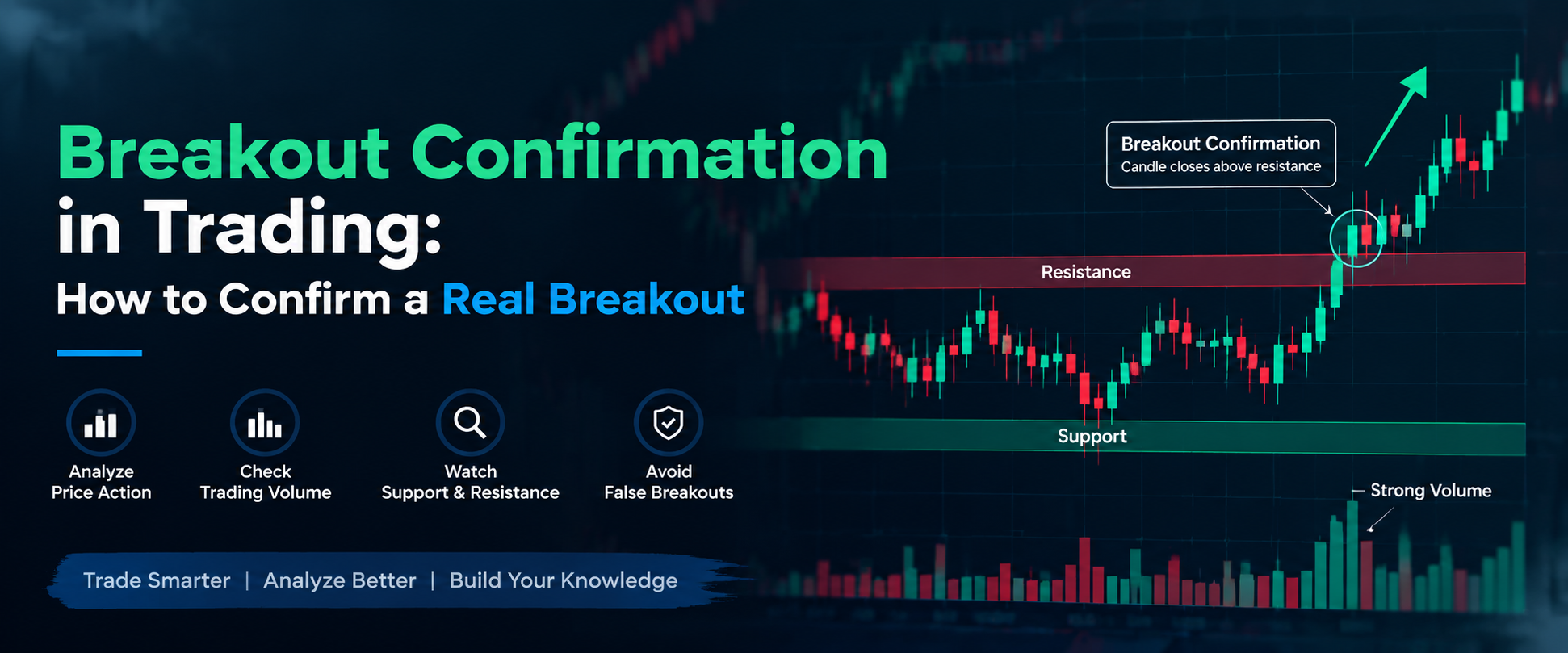
In technical analysis, traders often look for price movements that show a possible change in market direction. One of the most common situations is a breakout, where the price moves above resistance or below support after staying within a range.
However, not every breakout is real. Many traders enter too early because they react to the first price move without checking whether the breakout has enough strength behind it. This is where breakout confirmation becomes important.
Breakout confirmation helps traders evaluate whether a price move is more likely to be a genuine breakout or a false signal. It usually involves checking factors such as trading volume, candlestick patterns, support and resistance levels, and overall market conditions.
In this guide, Daily Dunia explains how to confirm a breakout, the signs of a real breakout, and common mistakes traders should avoid.
What Is Breakout Confirmation?
Breakout confirmation is the process of checking whether a price movement beyond a key level has enough evidence to be considered a valid breakout.
A breakout happens when the price moves beyond an important area, such as:
- Resistance level (a price area where sellers usually appear)
- Support level (a price area where buyers usually appear)
- Trading range boundaries
For example, if a stock has repeatedly failed to move above $50 and later breaks above this level, traders may see it as a potential breakout. However, the move is not always reliable immediately.
A confirmed breakout usually includes additional signs such as:
- Strong trading volume
- A candle closing above the breakout level
- Continued price movement after the breakout
- Support from other technical indicators
Breakout confirmation does not guarantee that a trade will succeed. Instead, it helps reduce the chance of entering during a false breakout.
Why Is Breakout Confirmation Important?
Many beginner traders make the mistake of buying as soon as the price crosses a resistance level. This can create problems because markets often create temporary moves that quickly reverse.
These temporary moves are known as false breakouts.
A false breakout occurs when the price moves beyond a key level but then returns back into the previous range.
For example:
- A stock moves above resistance at $100
- Traders expect further growth
- Buyers enter the market
- The price falls back below $100
Without confirmation, traders may enter positions based only on excitement or fear of missing a move.
Using breakout confirmation allows traders to analyze the strength behind the movement before making decisions.
You can also learn more about this concept through our guide on false breakout in trading, which explains why some breakouts fail.
How to Confirm a Real Breakout
There are several ways traders analyze whether a breakout is genuine. No single method works in every situation, but combining different signals can provide a clearer picture.
1. Wait for a Candle Close Above or Below the Level
One common confirmation method is waiting for the price candle to close beyond the breakout level.
For an upward breakout:
- Price moves above resistance
- The candle closes above resistance
- Buyers continue showing interest
For a downward breakout:
- Price moves below support
- The candle closes below support
- Selling pressure continues
A temporary move above resistance during a candle is not always enough evidence.
Many traders prefer waiting for confirmation rather than reacting to every price movement.
2. Check Breakout Volume
Volume is one of the most important factors in breakout confirmation.
Trading volume shows how much buying and selling activity is happening during a price move.
A strong breakout often has:
- Higher-than-normal volume
- Increased market participation
- Stronger buying or selling pressure
For example, if a stock breaks resistance with very low volume, traders may question whether the move has enough support.
On the other hand, a breakout with strong volume may indicate greater market interest.
However, volume should not be used alone. It works best when combined with other technical factors.
You can explore more about this topic in our article about trading volume and its role in market analysis.
Breakout Confirmation at Support and Resistance
Support and resistance are key concepts in breakout trading.
Support is a price area where buying interest may appear, while resistance is an area where selling pressure may increase.
A breakout becomes more meaningful when it happens around a strong support or resistance zone.
For example:
- A price tests resistance multiple times
- Buyers become stronger
- Price finally moves above the resistance level
- Volume increases
This may show stronger breakout conditions.
Similarly, when price breaks below an important support level, traders may look for confirmation that sellers are controlling the market.
Understanding support and resistance in trading can help traders identify important breakout areas before price movements happen.
Candlestick Confirmation for Breakouts
Candlestick patterns can provide additional information about breakout strength.
Some traders look for candles that show strong momentum, such as:
Strong Bullish Candle
A large bullish candle after breaking resistance may show strong buying interest.
Strong Bearish Candle
A large bearish candle after breaking support may indicate stronger selling pressure.
Breakout Retest Candle
Sometimes price breaks a level and then returns to test it again.
For example:
- Price breaks resistance
- Price falls back to the same level
- Buyers defend the level
- Price moves upward again
This is called a breakout retest and is often watched by technical traders.
Learning how to read a trading chart can help beginners understand these patterns more clearly.
Breakout Confirmation vs False Breakout
The biggest challenge in breakout trading is separating real breakouts from false ones.
A confirmed breakout often shows:
| Confirmed Breakout | False Breakout |
| Strong volume | Weak volume |
| Candle closes beyond the level | Temporary price move |
| Price continues in breakout direction | Price quickly reverses |
| Support/resistance level holds | Previous range returns |
A false breakout does not mean the market is predictable or easy to avoid. Even experienced traders encounter failed breakouts.
The goal of confirmation is not to remove all risk but to improve analysis.
Common Breakout Confirmation Mistakes
Beginner traders often make several mistakes when analyzing breakouts.
Entering Too Early
Buying immediately after a price crosses resistance can expose traders to false signals.
Waiting for confirmation may provide a clearer picture.
Ignoring Volume
A breakout without strong participation may not have enough momentum.
Using Only One Indicator
No technical tool works perfectly. Relying only on one signal can create misleading conclusions.
Ignoring Market Conditions
Overall market trends, news events, and economic conditions can influence price movements.
Good analysis requires looking at multiple factors.
How to Use Breakout Confirmation in a Trading Plan
Breakout confirmation should be part of a broader trading approach.
A basic process may include:
Step 1: Identify Important Levels
Find support, resistance, and trading ranges where price has reacted before.
Step 2: Watch for a Breakout
Monitor whether price moves beyond these important levels.
Step 3: Look for Confirmation
Check:
- Volume changes
- Candle closing position
- Retest behavior
- Market conditions
Step 4: Manage Risk
Traders often consider risk management techniques such as setting stop-loss levels and defining possible exit points.
A trading plan helps prevent emotional decisions and encourages a structured approach.
Daily Dunia regularly shares educational content about technical analysis, market concepts, and trading basics to help readers understand these topics better.
Stay Updated with Daily Dunia Trading Insights
Want more simple explanations about trading concepts, charts, and market education?
Follow Bull & Bear Whispers on Instagram for quick educational tips, visual breakdowns, and beginner-friendly trading content.
You can also join Bull & Bear Whispers our WhatsApp Channel to receive updates about new finance guides and educational articles directly.
Final Thoughts
Breakout confirmation is an important concept in technical analysis because it helps traders evaluate whether a price move has enough strength behind it.
A real breakout is usually supported by factors like volume, candle closing patterns, and strong support or resistance levels. However, confirmation cannot guarantee a successful trade because markets can change unexpectedly.
By learning how to confirm a breakout and avoiding common mistakes, beginners can develop a more structured approach to understanding breakout trading.