

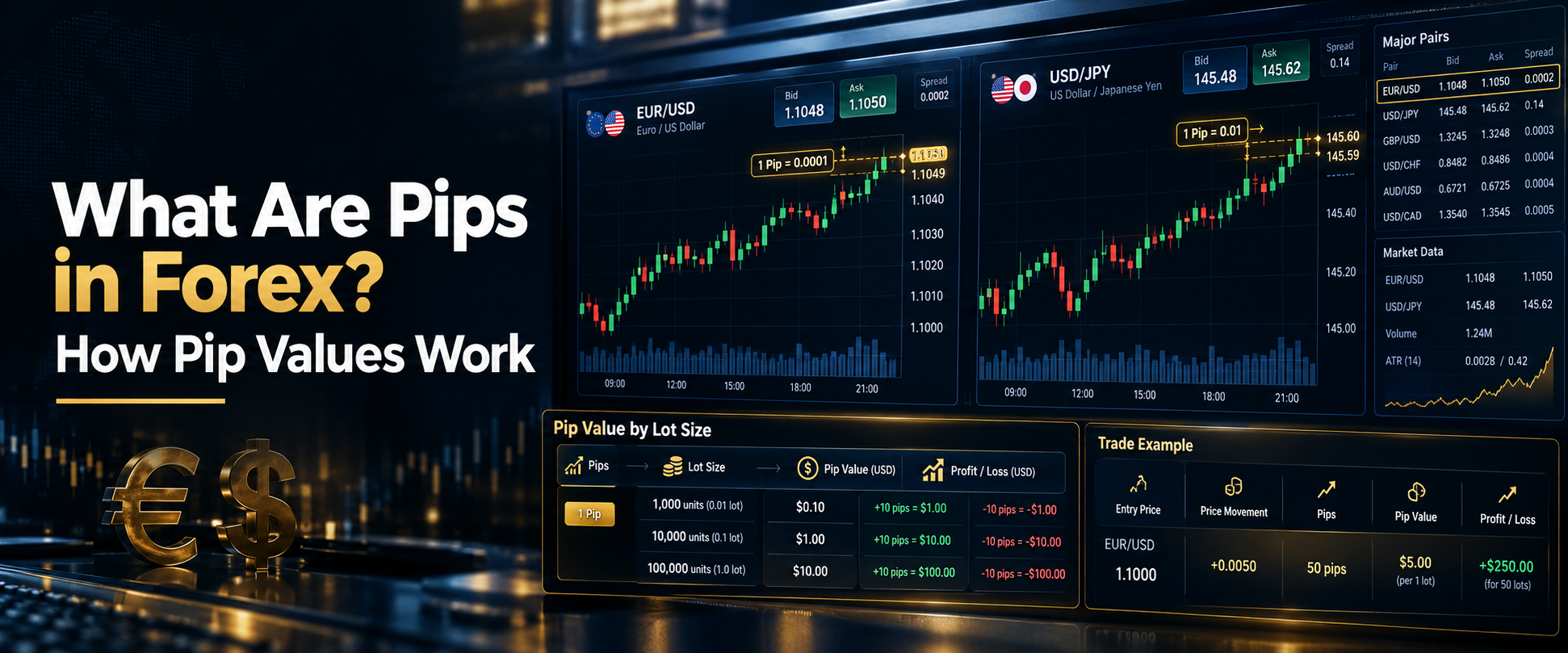
If you’ve just learned about currency pairs, the next key concept in forex is pips. A pip is the smallest standard unit that measures how much a currency pair’s price moves. Understanding pips helps you read quotes, calculate profit or loss, and manage risk.
At Daily Dunia, we explain trading basics in simple language so beginners can build confidence before they start trading. In this guide, you’ll learn what are pips in forex, how they work, and how to calculate pip value with clear examples.
What Are Pips in Forex?
A pip stands for “percentage in point” or “price interest point.” It’s the smallest standard price movement in a currency pair.
For most pairs, 1 pip = 0.0001 (the fourth decimal place).
For Japanese yen (JPY) pairs, 1 pip = 0.01 (the second decimal place).
Example (non-JPY pair):
If EUR/USD moves from 1.1000 to 1.1001, that’s a 1-pip move.
Example (JPY pair):
If USD/JPY moves from 145.00 to 145.01, that’s also a 1-pip move.
Pips are used across forex trading basics to talk about spreads, profit, loss, and risk in a standard way.
How Do Pips Measure Price Movement?
Pips measure currency price movement in a consistent way, no matter which pair you’re watching. Instead of saying “the price moved a little,” traders say “it moved 10 pips” or “50 pips.”
Because most pairs are quoted to 4 decimal places, the last digit represents pips. When that digit changes by 1, the price has moved by 1 pip.
This standardization makes it easier to:
- Compare moves across different pairs
- Calculate potential profit and loss
- Set stop loss and take profit levels
How to Calculate Pips in Forex
To calculate pips in forex, find the difference between two prices and divide by the pip size.
Formula:
\text{Pips} = \frac{\text{Exit Price} – \text{Entry Price}}{\text{Pip Size}}
- For most pairs: Pip Size = 0.0001
- For JPY pairs: Pip Size = 0.01
Example 1: EUR/USD
- Entry: 1.1000
- Exit: 1.1050
- Difference: 1.1050 − 1.1000 = 0.0050
- Pips: 0.0050 ÷ 0.0001 = 50 pips
Example 2: USD/JPY
- Entry: 145.00
- Exit: 145.60
- Difference: 145.60 − 145.00 = 0.60
- Pips: 0.60 ÷ 0.01 = 60 pips
This method works for both long (buy) and short (sell) trades.
What Is Pip Value?
Pip value tells you how much money 1 pip is worth in your account currency. It depends on:
- The currency pair you’re trading
- Your position size (lot size)
- Your account currency (e.g., USD, EUR, PKR)
Basic formula (when your account currency is the quote currency):
\text{Pip Value} = \text{Pip Size} \times \text{Position Size (in units)}
Example: EUR/USD, 1 standard lot (100,000 units), USD account
- Pip Size = 0.0001
- Position Size = 100,000
- Pip Value = 0.0001 × 100,000 = $10 per pip
If you trade a mini lot (10,000 units), pip value = $1.
If you trade a micro lot (1,000 units), pip value = $0.10.
For pairs where your account currency is not the quote currency, an extra conversion step is needed. Many brokers provide pip calculators to simplify this.
Pipettes vs Pips
Some brokers show prices with an extra decimal place. This fractional pip is called a pipette (or “fractional pip”).
- Pip: 4th decimal place for most pairs (0.0001)
- Pipette: 5th decimal place (0.00001) = 1/10 of a pip
Example:
If EUR/USD is quoted as 1.10508, then:
- 1.1050 = the pip level
- The last digit “8” = 8 pipettes (0.8 of a pip)
For JPY pairs:
- Pip = 2nd decimal (0.01)
- Pipette = 3rd decimal (0.001)
Pipettes give more precise pricing but don’t change the basic idea of how pips work.
Why Are Pips Important in Forex?
Pips are central to forex trading basics because they:
- Standardize how we talk about price movement
- Help calculate profit and loss in a clear way
- Are used to set stop loss and take profit levels
- Help compare risk across different currency pairs
Without pips, traders would have to describe moves in raw price terms, which changes from pair to pair. Pips make communication and planning much simpler.
Pips and Currency Pairs
Different currency pairs can have different pip values, even if the pip size looks the same.
- Majors (like EUR/USD, GBP/USD) usually have tight spreads (e.g., 0.5–2 pips).
- Minors and exotics can have wider spreads (5, 10, or more pips).
Also, remember:
- For most pairs: pip = 0.0001
- For JPY pairs: pip = 0.01
This is why it’s important to check the pair’s quoting convention before you calculate pips.
If you’re new, reviewing What Are Currency Pairs in Forex? can help you connect these ideas.
Pips, Profit, and Loss
Traders often express profit and loss in pips first, then convert to money using pip value.
Example:
- You buy 1 mini lot (10,000 units) of EUR/USD.
- Entry: 1.1000
- Exit: 1.1030
- Move: 30 pips
- Pip value (USD account, mini lot): ~$1 per pip
- Profit: 30 pips × $1 = $30 (before costs)
If the trade goes against you by 30 pips, your loss would be about $30. This shows how pips link directly to risk and reward.
Always remember: currency prices can move quickly, and forex trading involves risk. Never risk more than you can afford to lose.
How Pips Relate to Stop Loss and Take Profit
Stop loss and take profit orders are often set in pips.
- Stop loss: limits how many pips you’re willing to lose.
- Take profit: defines how many pips you want to gain.
Example:
- You buy EUR/USD at 1.1000.
- Stop loss: 1.0970 → 30 pips risk
- Take profit: 1.1060 → 60 pips target
Here, your risk-to-reward ratio is 30:60 or 1:2 in pips. You can then convert these pips to money using your position size and pip value.
Understanding this helps with What Is Risk Management in Trading? and What Is Position Sizing in Trading?.
Common Pip Mistakes Beginners Make
New traders often make these pip-related mistakes:
- Confusing pips with money – 50 pips can mean very different amounts depending on lot size and pair.
- Ignoring JPY pip rules – forgetting that JPY pairs use 2 decimal places for pips.
- Using huge stop losses in pips – risking hundreds of pips without calculating the real money risk.
- Not accounting for spreads – entering a trade already “negative” by the spread in pips.
- Overtrading small pip moves – trying to profit from 1–2 pip moves while paying wide spreads.
To avoid these, practice with a demo account and review guides like What Is a Stop Loss in Trading? and What Is Take Profit in Trading?.
FAQs
What is a pip in forex?
A pip is the smallest standard price movement in a currency pair, usually 0.0001 for most pairs and 0.01 for JPY pairs. It’s used to measure changes in exchange rates and calculate profit or loss.
How much is 1 pip in forex?
For most pairs, 1 pip = 0.0001 of the quote currency. For JPY pairs, 1 pip = 0.01. The actual money value of 1 pip depends on your position size and account currency.
How do you calculate pips?
Subtract the entry price from the exit price, then divide by the pip size (0.0001 or 0.01 for JPY). For example, a move from 1.1000 to 1.1050 in EUR/USD is 50 pips.
What is the difference between a pip and a pipette?
A pipette is one-tenth of a pip. Pips are in the 4th decimal place (or 2nd for JPY), while pipettes are in the 5th decimal place (or 3rd for JPY). Pipettes allow more precise pricing.
Why are pips important in forex trading?
Pips provide a standard way to measure currency price movement, calculate profit and loss, set stop loss and take profit levels, and compare risk across different pairs. They are a core part of forex trading basics.
Final Thoughts
Pips are the basic unit of measurement in forex. Once you understand pip meaning in forex, how to calculate pips in forex, and how pip value changes with pair and position size, you’ll be able to plan trades and manage risk more clearly.
As you keep learning, connect this topic with What Is Forex Trading?, What Are Currency Pairs in Forex?, What Is Leverage in Trading?, and What Is Risk Management in Trading? to build a complete picture.
Remember, forex trading involves risk, and prices can move fast. Focus on education and risk control before chasing profits. For more beginner-friendly guides on trading and finance, stay with Daily Dunia. You can also follow the Daily Dunia Instagram and join our WhatsApp Channel for new lessons and updates.


