

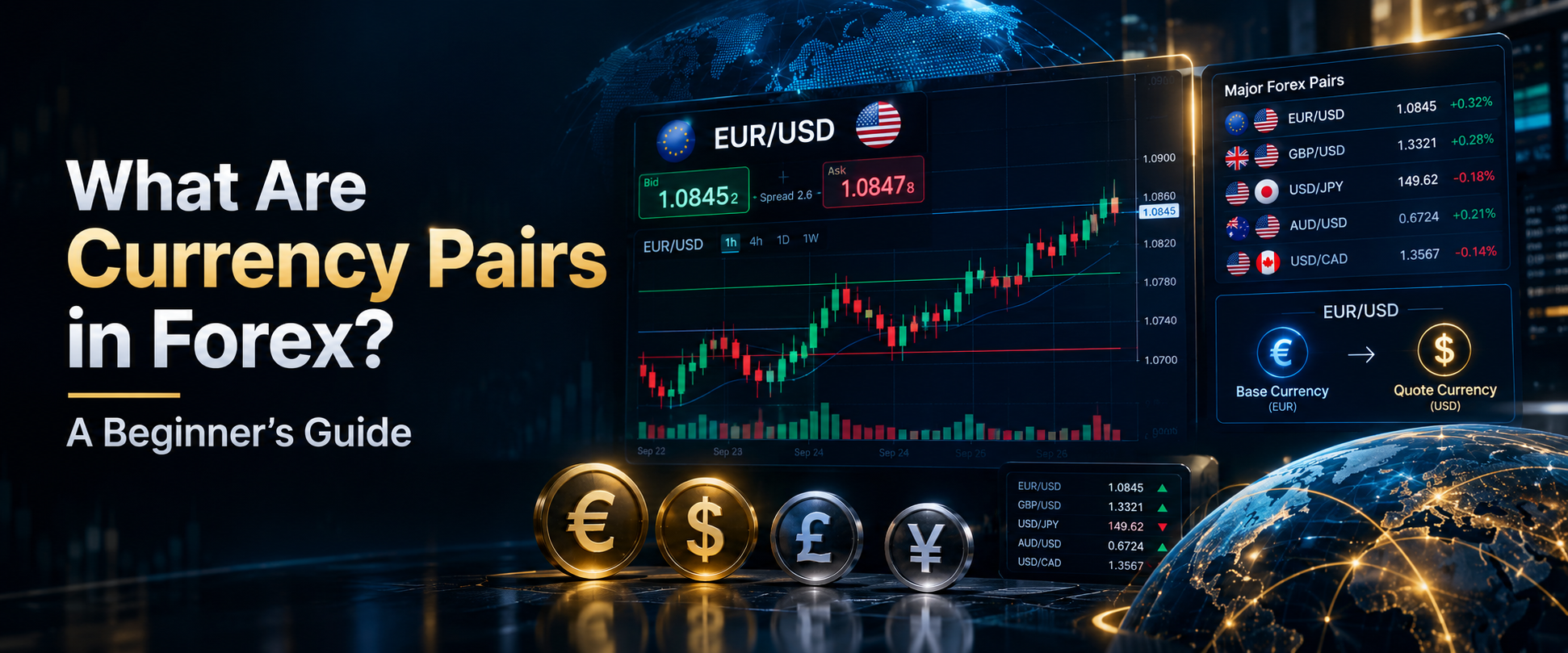
If you’ve just learned what forex trading is, the next big idea to understand is currency pairs. In forex, you never buy or sell a single currency alone—you always trade one currency against another. That’s why every forex quote comes as a pair, like EUR/USD or USD/JPY.
At Daily Dunia, we break down complex trading topics into simple, beginner-friendly guides so you can build a strong foundation before you start trading.
What Are Currency Pairs in Forex?
A currency pair shows the value of one currency compared to another. It tells you how much of the second currency you need to buy one unit of the first currency.
For example, if EUR/USD = 1.1000, it means 1 euro can be exchanged for 1.10 US dollars. Here, the euro is the first currency (base), and the US dollar is the second (quote).
All forex trading happens in pairs. You’re always buying one currency and selling another at the same time.
How Do Currency Pairs Work?
Currency pairs work like an exchange rate between two countries. The price moves up or down based on how strong or weak each currency is compared to the other.
When you buy a currency pair, you’re:
- Buying the base currency
- Selling the quote currency
When you sell a currency pair, you’re:
- Selling the base currency
- Buying the quote currency
So if you buy EUR/USD, you expect the euro to get stronger against the US dollar. If you sell it, you expect the euro to get weaker.
What Are Base and Quote Currencies?
Every currency pair has two parts:
- Base currency: The first currency in the pair (on the left). It’s the one you’re buying or selling.
- Quote currency: The second currency in the pair (on the right). It shows how much of this currency equals one unit of the base.
Example: EUR/USD = 1.1000
- Base currency: EUR (euro)
- Quote currency: USD (US dollar)
- Meaning: 1 euro = 1.10 US dollars
If the price rises to 1.1100, the euro has strengthened. If it falls to 1.0900, the euro has weakened.
What Are Major Currency Pairs?
Major currency pairs are the most traded pairs in the forex market. They all include the US dollar and come from large, stable economies.
The main majors are:
- EUR/USD – Euro / US dollar
- USD/JPY – US dollar / Japanese yen
- GBP/USD – British pound / US dollar
- USD/CHF – US dollar / Swiss franc
- AUD/USD – Australian dollar / US dollar
- USD/CAD – US dollar / Canadian dollar
- NZD/USD – New Zealand dollar / US dollar
Majors have:
- High liquidity (easy to buy and sell)
- Lower spreads (cost of trading)
- Lots of news and analysis available
Because of this, many beginners start with major pairs.
What Are Minor Currency Pairs?
Minor currency pairs (also called crosses) do not include the US dollar. They still involve major currencies, just not against the USD.
Examples:
- EUR/GBP – Euro / British pound
- EUR/JPY – Euro / Japanese yen
- GBP/JPY – British pound / Japanese yen
- AUD/CAD – Australian dollar / Canadian dollar
Minors usually have:
- Slightly lower liquidity than majors
- Wider spreads
- Still enough volume for most retail traders
They’re useful if you want to trade relationships between non-USD currencies.
What Are Exotic Currency Pairs?
Exotic currency pairs pair a major currency with a currency from an emerging or smaller economy.
Examples:
- USD/TRY – US dollar / Turkish lira
- USD/ZAR – US dollar / South African rand
- USD/SGD – US dollar / Singapore dollar
- EUR/TRY – Euro / Turkish lira
Exotics often have:
- Lower liquidity
- Much wider spreads
- Higher sensitivity to local news and politics
Because of the higher costs and risk, exotics are usually not ideal for complete beginners.
How to Read a Forex Currency Pair
Reading a currency pair is simple once you know the order:
Format: BASE/QUOTE = PRICE
Example: GBP/USD = 1.2700
- Base: GBP (British pound)
- Quote: USD (US dollar)
- Price: 1.2700
- Meaning: 1 British pound = 1.27 US dollars
If you think the pound will rise against the dollar, you buy GBP/USD.
If you think it will fall, you sell GBP/USD.
Always remember:
- First currency = base (what you’re trading)
- Second currency = quote (what you’re measuring it in)
What Makes Currency Pairs Move?
Currency prices change because of many factors, including:
- Interest rates set by central banks
- Economic data like GDP, inflation, and employment
- Political events and elections
- Market sentiment (risk-on vs. risk-off)
- Global news and crises
For example, if the US raises interest rates while Europe keeps them low, USD may strengthen against EUR, pushing EUR/USD down.
Prices can move very quickly, especially during major news releases. That’s why understanding risk is so important before you trade.
Currency Pairs and Liquidity
Liquidity means how easily you can buy or sell something without moving the price too much.
- Majors are the most liquid. You can enter and exit trades quickly with small spreads.
- Minors are less liquid but still tradable for most people.
- Exotics can have low liquidity, leading to bigger spreads and slippage.
Higher liquidity usually means:
- Tighter spreads
- More stable prices
- Better execution
If you’re new to currency pair trading, starting with liquid major pairs can help you learn with lower costs and clearer price action.
Common Mistakes Beginners Make
Here are some frequent errors new traders make with currency pairs:
- Trading too many pairs at once – Focus on 1–3 pairs to understand their behavior.
- Ignoring the quote currency – Remember, both sides of the pair matter.
- Choosing exotics too early – Wide spreads and volatile moves can hurt beginners.
- Not checking economic calendars – Big news can cause sudden spikes.
- Using too much leverage – Leverage can magnify both profits and losses.
To avoid these, learn the basics of What Is Leverage in Trading? and What Is Risk Management in Trading? before going live.
FAQs
What is a currency pair in forex?
A currency pair is two currencies quoted together, showing how much of the second (quote) currency is needed to buy one unit of the first (base) currency. All forex trades involve buying one currency and selling another.
What are the major currency pairs?
The major currency pairs are the most traded pairs that include the US dollar: EUR/USD, USD/JPY, GBP/USD, USD/CHF, AUD/USD, USD/CAD, and NZD/USD. They have high liquidity and tighter spreads.
What is the difference between major and minor currency pairs?
Major pairs include the US dollar and come from large economies. Minor pairs (crosses) do not include the US dollar but still involve major currencies. Minors usually have lower liquidity and wider spreads than majors.
What are exotic currency pairs?
Exotic currency pairs combine a major currency with a currency from an emerging or smaller economy (e.g., USD/TRY, USD/ZAR). They tend to have lower liquidity, wider spreads, and higher volatility, making them riskier for beginners.
How do you read a currency pair?
Read a pair as BASE/QUOTE = PRICE. The first currency is the base; the second is the quote. For example, EUR/USD = 1.1000 means 1 euro equals 1.10 US dollars. If the price rises, the base currency is strengthening against the quote.
Final Thoughts
Currency pairs are the building blocks of forex trading. Once you understand what are currency pairs, how base and quote currencies work, and the difference between major, minor, and exotic currency pairs, you’ll be able to read charts and news with much more confidence.
As you continue your learning journey, explore related topics like How Does Trading Work?, What Is Liquidity in Trading?, What Is Trading Volume?, and What Is Technical Analysis in Trading? to deepen your knowledge.
Remember, currency prices can move quickly, and trading involves risk. Never trade with money you can’t afford to lose, and always focus on learning before chasing profits. For more simple, people-first guides on trading and finance, stay connected with Daily Dunia. You can also follow our updates on the Daily Dunia Instagram and join our Bull & Bear Whispers WhatsApp Channel for new articles and learning resources.


