If you have been reading about trading on Daily Dunia, you may have seen the term “forex” many times. But what exactly is forex trading, and how does the forex market work? This guide explains forex trading in simple words so beginners can understand the basics before going deeper into trading strategies.
What Is Forex Trading?
Forex trading (short for foreign exchange trading) means buying one currency and selling another at the same time. People trade currencies because they believe the value of one currency will go up or down compared to another.
For example, if you think the Euro will become stronger than the US Dollar, you might buy EUR/USD. If the Euro does get stronger, you can sell it later for a profit. But if it gets weaker, you could lose money. Forex trading always involves risk.
Forex is the largest financial market in the world. Every day, trillions of dollars are traded in the forex market by banks, companies, governments, and individual traders.
How Does the Forex Market Work?
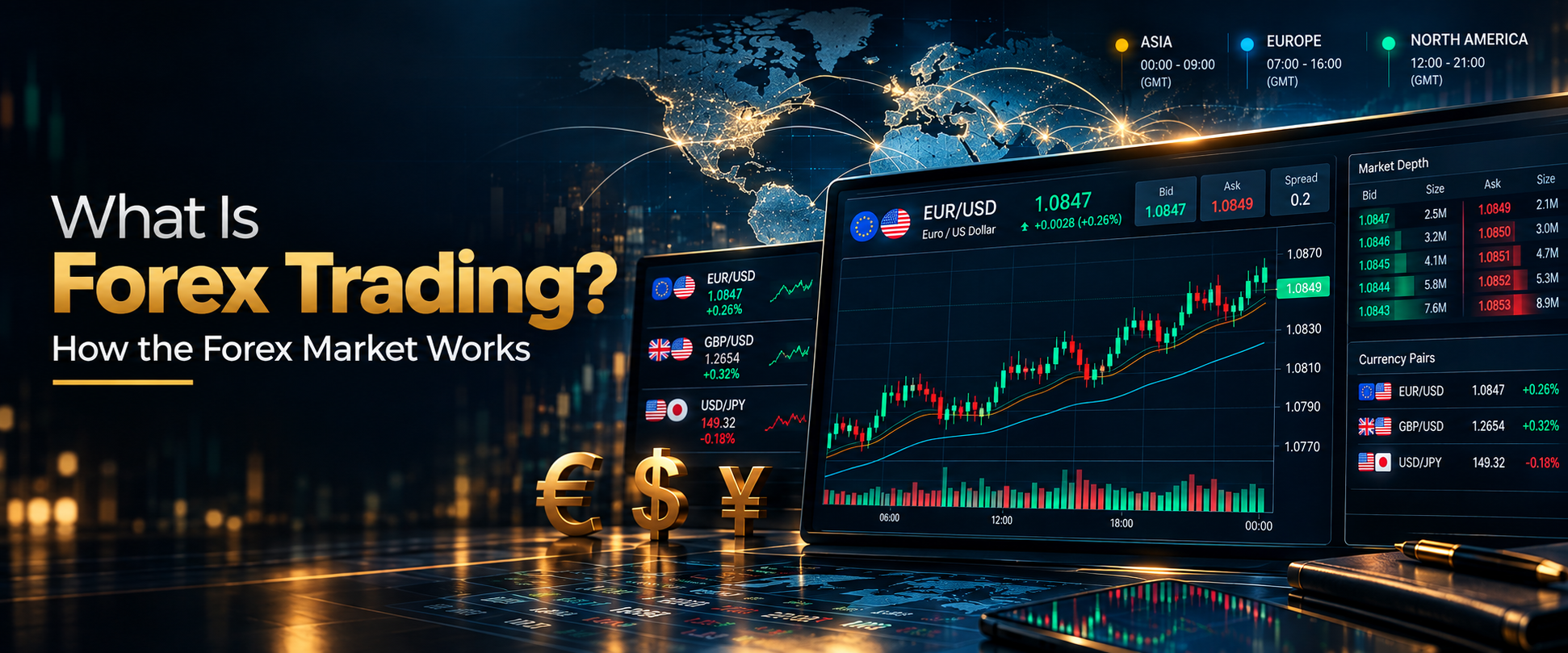
The forex market is not in one place like a stock exchange. It is a global, decentralized market that runs 24 hours a day, five days a week. Trading happens online through brokers and platforms.
When the market opens in Asia, then Europe, and then North America, different traders become active at different times. This is why the forex market is open almost all the time from Monday to Friday.
Prices in the forex market change every second because of supply and demand. Many factors affect currency prices, such as:
- Economic data (like GDP, inflation, jobs reports)
- Interest rates set by central banks
- Political news and global events
- Market sentiment (how traders feel about risk)
All these things make currency values move up and down.
What Are Currency Pairs?
In forex, currencies are always traded in pairs. A currency pair shows how much of one currency you need to buy one unit of another currency.
For example, in the pair EUR/USD:
- The first currency (EUR) is called the base currency.
- The second currency (USD) is called the quote currency.
If EUR/USD is 1.1000, it means 1 Euro = 1.10 US Dollars.
When you buy EUR/USD, you are buying Euros and selling US Dollars. When you sell EUR/USD, you are selling Euros and buying US Dollars.
Major, Minor, and Exotic Currency Pairs
Currency pairs are grouped into three main types:
Major Pairs
Major pairs include the US Dollar and the most traded currencies in the world. Examples:
- EUR/USD (Euro / US Dollar)
- USD/JPY (US Dollar / Japanese Yen)
- GBP/USD (British Pound / US Dollar)
- USD/CHF (US Dollar / Swiss Franc)
These pairs usually have high liquidity and lower spreads.
Minor Pairs (Crosses)
Minor pairs do not include the US Dollar but still involve major currencies. Examples:
- EUR/GBP (Euro / British Pound)
- EUR/JPY (Euro / Japanese Yen)
- GBP/JPY (British Pound / Japanese Yen)
Exotic Pairs
Exotic pairs include one major currency and one currency from a smaller or emerging economy. Examples:
- USD/TRY (US Dollar / Turkish Lira)
- USD/PKR (US Dollar / Pakistani Rupee)
- EUR/TRY (Euro / Turkish Lira)
Exotic pairs often have higher spreads and can be more volatile.
How Do Traders Make Decisions in Forex?
Forex traders use two main types of analysis to make decisions:
Fundamental Analysis
This means looking at economic and political factors that can affect currency values. Traders watch:
- Interest rate decisions
- Inflation reports
- Employment data
- Government policies and news
For example, if a country raises its interest rates, its currency may become stronger because investors want higher returns.
Technical Analysis
This means studying price charts and patterns to guess where the price might go next. Traders use:
- Candlestick patterns
- Support and resistance levels
- Indicators like moving averages, RSI, MACD
Technical analysis helps traders decide when to enter and exit trades. If you want to learn more, you can read our article on What Is Technical Analysis in Trading?.
Most traders use a mix of both fundamental and technical analysis.
What Is a Forex Price Quote?
A forex price quote shows the current price of a currency pair. It has two prices:
- Bid price: The price at which you can sell the base currency.
- Ask price: The price at which you can buy the base currency.
For example, if EUR/USD is quoted as 1.1000 / 1.1002:
- You can sell 1 Euro for 1.1000 US Dollars (bid).
- You can buy 1 Euro for 1.1002 US Dollars (ask).
The difference between the bid and ask price is called the spread.
What Are Spread, Leverage, and Margin?
These are three important concepts in forex trading.
Spread
The spread is the difference between the bid and ask price. It is how many brokers make money. A lower spread means lower trading cost.
For example, if EUR/USD is 1.1000 / 1.1002, the spread is 2 pips.
Leverage
Leverage allows traders to control a larger position with a smaller amount of money. For example, with 1:100 leverage, you can control $10,000 with only $100 of your own money.
Leverage can increase both potential gains and potential losses. This is why leverage is risky, especially for beginners. Many new traders lose money quickly when they use high leverage.
You can learn more in our guide: What Is Leverage in Trading?.
Margin
Margin is the money you need to keep in your account to open and maintain a leveraged position. If your losses become too big, the broker may close your trade automatically (this is called a margin call).
What Are the Main Risks of Forex Trading?
Forex trading is not a guaranteed way to make money. It involves serious risks, including:
- Market risk: Prices can move against you very fast.
- Leverage risk: Leverage can magnify losses as well as gains.
- Liquidity risk: In some pairs or times, it may be hard to enter or exit trades at good prices.
- Broker risk: Not all brokers are regulated or trustworthy.
- Emotional risk: Fear and greed can make traders take bad decisions.
Because of these risks, it is very important to learn about What Is Risk Management in Trading? before you start trading with real money.
Never trade with money you cannot afford to lose.
Forex Trading vs Stock Trading
Many beginners ask: is forex trading better than stock trading, or vice versa? Here are some key differences:
| Feature | Forex Trading | Stock Trading |
| Market hours | 24 hours, 5 days a week | Usually exchange hours (e.g., 9:30–4:00) |
| Assets traded | Currency pairs | Shares of companies |
| Market size | Largest financial market in the world | Large, but smaller than forex |
| Leverage | Often very high | Usually lower |
| Main drivers | Economic data, interest rates, geopolitics | Company performance, earnings, news |
| Typical holding time | Minutes to days (often short-term) | Days to years (often longer-term) |
Both markets have opportunities and risks. For a broader view, you can read What Is Trading? and How Does Trading Work? on Daily Dunia.
Common Forex Trading Mistakes Beginners Make
New forex traders often make similar mistakes, such as:
- Using too much leverage – This can wipe out an account very fast.
- No risk management – Not using stop-loss or risking too much per trade.
- Overtrading – Taking too many trades without a clear plan.
- Following signals blindly – Copying others’ trades without understanding why.
- Ignoring education – Jumping into live trading before learning the basics.
To avoid these mistakes, start with a demo account, learn Trading Basics Explained, and focus on risk management before thinking about profits.
FAQs
What is forex trading in simple words?
Forex trading means buying one currency and selling another at the same time, hoping that the exchange rate will move in your favor. It is done in the global forex market, where currencies are traded 24 hours a day, five days a week.
How does forex trading work?
Forex trading works through currency pairs like EUR/USD. Traders use brokers to place buy or sell orders. Prices change based on supply and demand, economic data, interest rates, and global events. Traders try to profit from these price movements.
Is forex trading suitable for beginners?
Forex trading can be learned by beginners, but it is risky. Beginners should start with education, use demo accounts, and avoid high leverage. It is important to understand that many new traders lose money, especially when they trade without a plan.
What is a currency pair?
A currency pair shows how much of one currency is needed to buy another. For example, in EUR/USD, the Euro is the base currency and the US Dollar is the quote currency. If EUR/USD is 1.1000, then 1 Euro = 1.10 US Dollars.
What are the main risks of forex trading?
The main risks include market risk (prices moving against you), leverage risk (losses can be bigger than your deposit), liquidity risk, broker risk, and emotional risk. Proper risk management and education are essential to reduce these risks.
Final Thoughts
Forex trading is a big, fast-moving market where currencies are bought and sold all around the world. Understanding what is forex trading and how the forex market works is the first step before you think about strategies or signals.
If you are serious about learning, focus on education, risk management, and small, controlled steps. Daily Dunia is here to help you with clear, beginner-friendly guides on trading and finance. For more updates and learning content, you can also follow Bull & Bear Whispers on Instagram.
If you want regular tips and new articles, join our Bull & Bear Whispers WhatsApp Channel so you never miss an update.
Remember: forex trading involves risk. Never trade with money you cannot afford to lose, and always keep learning.