What Is Take Profit in Trading and How Does It Work?
If you are new to trading, you have probably heard the term “take profit” many times. It sounds simple, but many beginners still don’t fully understand how it works or why it matters. In this article, we will explain take profit in trading in plain, easy language, so you can understand exactly what it does and how traders use it as part of their exit strategy.
What Is Take Profit in Trading?
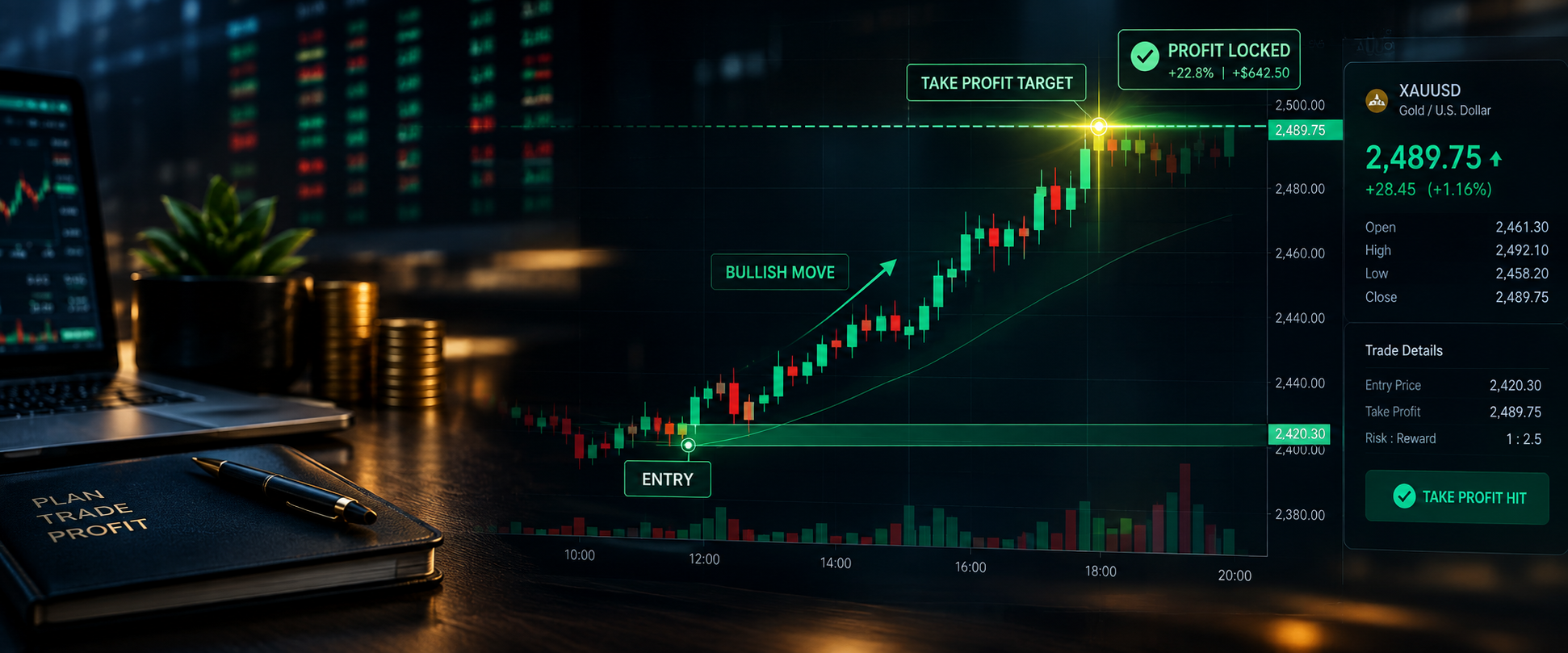
Take profit is a price level that a trader sets in advance to close a trade once it becomes profitable. In simple words, it is the point where a trader decides, “This is enough profit for this trade, and I want to lock it in.”
Instead of watching the market every minute and deciding manually when to exit, a trader can set this level beforehand. Once the market price reaches that level, the trade closes automatically. This is why it is often paired with a stop loss, which works the same way but on the losing side of a trade.
How Does a Take Profit Order Work?
A take profit order works by connecting a specific price to your open trade. When you open a position, most trading platforms let you set a take profit price along with your entry price and stop loss price.
Here is the basic process:
- You enter a trade at a certain price.
- You choose a target price where you want to exit with profit.
- The platform tracks the market price automatically.
- When the price touches your take profit level, the trade closes on its own.
This means you don’t have to sit and watch charts all day. The order does the work for you, which is one reason it is popular among both new and experienced traders.
Take Profit Example
Let’s look at a simple example to make this clearer.
Suppose a trader buys a stock at $50 per share. Based on their analysis, they believe the price could rise to $55 before facing resistance. So they set their take profit order at $55.
If the price moves up and touches $55, the trade closes automatically, and the trader secures a $5 profit per share. If the price never reaches $55, the trade stays open until the trader decides to close it manually or another exit condition, like a stop loss, is triggered.
This example shows how a take profit order removes guesswork from the exit decision, since the target is already decided in advance.
Take Profit vs Stop Loss: What’s the Difference?
People often ask about take profit vs stop loss, since both are exit tools but serve opposite purposes.
- Take profit closes a trade when the price moves in your favor and reaches a target level.
- Stop loss closes a trade when the price moves against you, to limit further loss.
Think of them as two boundaries around a trade. One protects your downside, and the other locks in your upside. Using both together is a common practice in risk management in trading, because it gives a trader a clear plan for both outcomes before the trade even begins.
Why Do Traders Use Take Profit Orders?
Traders use take profit orders mainly to bring discipline and structure into their trading. Some possible benefits include:
- Reducing emotional decision-making during a trade
- Locking in gains without needing to monitor the market constantly
- Making it easier to follow a predefined trading plan
- Helping traders think about risk and reward before entering a trade
It is important to understand that a take profit order does not guarantee profits. Markets can be unpredictable, and price may never reach the chosen target, or it may reverse sharply before getting there. Take profit is a tool for managing exits, not a promise of success.
How Do Traders Choose a Take Profit Level?
Choosing where to place a take profit level is not random. Traders usually rely on a mix of analysis and planning, including:
Support and resistance: Many traders place take profit levels near known resistance zones, where price has struggled to rise past before.
Risk-reward ratio: This compares potential loss to potential gain. For example, a 1:2 risk-reward ratio means a trader is willing to risk $1 to potentially gain $2.
Chart patterns: Patterns like triangles, channels, or trend lines can help traders estimate how far a price move might go.
Technical indicators: Tools such as moving averages or Fibonacci levels are sometimes used to identify realistic target zones.
Trading plan: A trader’s overall strategy, timeframe, and goals also influence where they set their target. This connects closely with having a well-defined trading plan before entering any position.
Take Profit and Risk Management
Exit planning should always be considered before entering a trade, not after. This is one of the core ideas behind risk management in trading. A trader who decides both their stop loss and take profit levels in advance is far less likely to make impulsive decisions once the trade is live.
Planning your exit ahead of time also helps you evaluate whether a trade is worth taking in the first place. If the potential reward doesn’t justify the risk, it may be better to skip that trade altogether. This kind of thinking is closely tied to choosing a good trading entry point as well, since entry and exit decisions work together as a complete strategy.
By the way, if you want more simple breakdowns like this one, Daily Dunia also shares quick trading and finance tips on Instagram, which can be a good way to reinforce these concepts visually.
Take Profit vs Manually Closing a Trade
Some traders prefer to close trades manually instead of using a fixed take profit order. The basic difference is this:
- Take profit order: The exit happens automatically once the price hits your chosen level, even if you are away from your screen.
- Manual closing: You decide in real time when to exit, based on how the market looks at that moment.
Manual closing gives more flexibility, but it also requires constant attention and can be influenced more easily by emotions. A take profit order removes that pressure, though it also means you might exit a bit early if the price continues moving favorably after your target is hit.
Common Take Profit Mistakes Beginners Make
Beginners often make a few avoidable mistakes when using take profit orders:
- Setting unrealistic targets that are far beyond what the market typically moves
- Entering a trade without any exit plan, and only thinking about take profit after the trade is already open
- Changing the target out of emotion, such as moving it higher out of greed when the price is approaching the original level
- Ignoring overall market conditions, like high volatility or major news events, when setting a target
- Confusing take profit with guaranteed profit, when in reality it is simply a planned exit point, not a promise
Avoiding these mistakes usually comes down to preparation. This is also connected to good position sizing in trading, since how much you trade affects how meaningful your take profit level actually is.
Should Every Trade Have a Take Profit?
This is a common question, and there isn’t a single right answer for everyone. Some traders set a take profit for every trade because it fits their strategy and helps them stay disciplined. Others prefer to trail their exits manually or use different tools depending on market conditions.
What matters most is that a trader has thought through their exit strategy in some form, whether that is a fixed take profit order, a manual approach, or a combination of both. This article is for educational purposes only and does not provide personalized trading advice. Every trader’s approach should match their own goals, risk tolerance, and experience level.
Final Thoughts
Take profit is a simple but important part of a trader’s exit strategy. It allows traders to lock in gains at a predetermined level instead of relying purely on in-the-moment decisions. When used alongside tools like stop loss orders, support and resistance analysis, and a clear risk-reward ratio, take profit becomes part of a broader trading exit strategy rather than a standalone trick.
As with all trading concepts, understanding take profit is only useful when combined with practice, patience, and continuous learning. For more detailed explanations of trading terms, resources like Investopedia are a good place to explore further.
Want more beginner-friendly trading guides like this one? Follow the Bull & Bear Whispers WhatsApp Channel for new articles on trading, finance, and risk management.