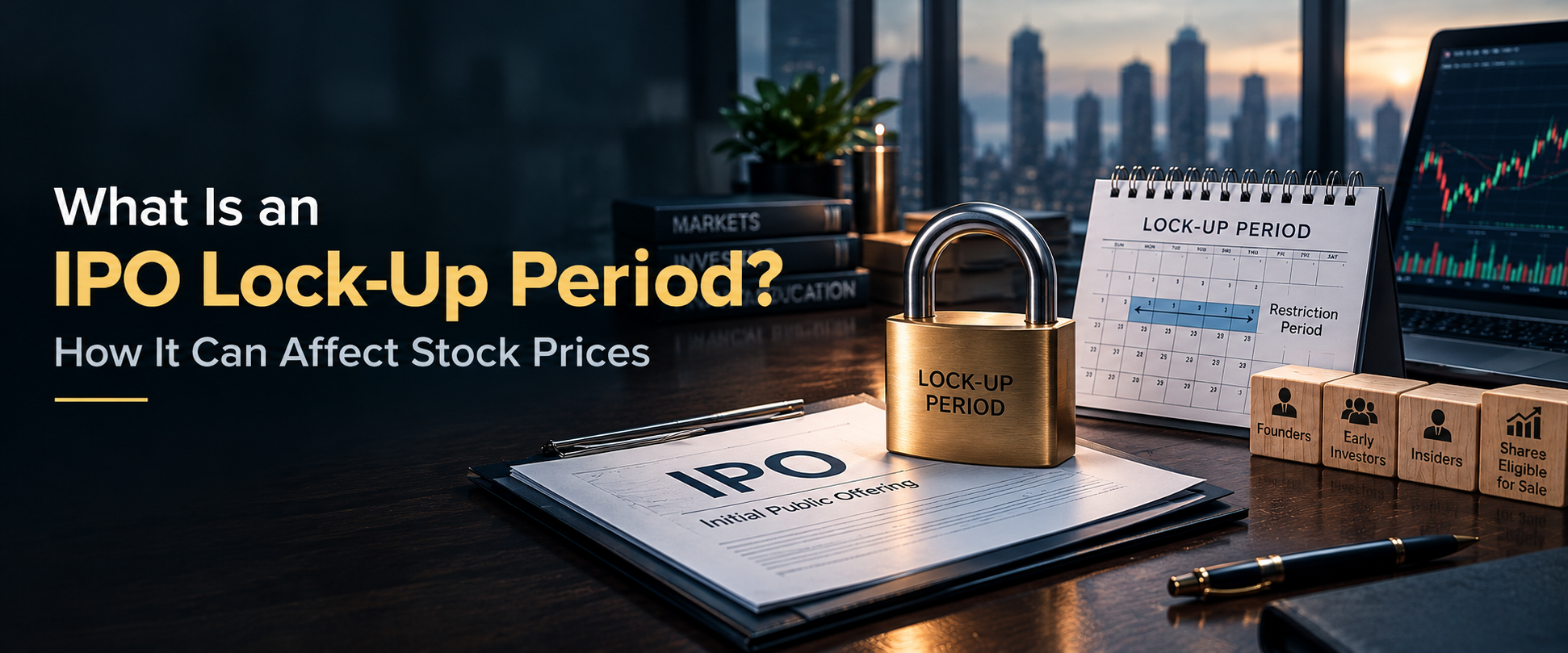
An IPO lock-up period is a specified time during which certain existing shareholders agree not to sell their shares after a company goes public. Public investors may be trading the stock while founders, employees, or early investors remain subject to these restrictions.
The arrangement matters because it limits how quickly some existing shares can enter the public market. When the restriction expires, additional shares may become available for sale, potentially affecting supply and demand.
In this Daily Dunia guide, you will learn how lock-ups work, why expiration matters, and why it does not guarantee a particular stock-price movement.
What Is an IPO Lock-Up Period?
An initial public offering, or IPO, generally means the first time a company offers its shares to the public.
A lock-up agreement in stocks temporarily restricts specified shareholders from selling covered holdings. It does not normally prevent everyone from trading the company’s publicly available shares.
Before an IPO, insiders and underwriters typically enter into these agreements. Underwriters are the investment banks that manage and sell the offering.
Investor.gov’s explanation of IPO lockup agreements says they help prevent insiders’ shares from entering the public market too soon after the offering.
Think of a lock-up as a restriction on particular holdings, not a guarantee about the company’s value.
How Does an IPO Lock-Up Period Work?
The agreement identifies who is restricted, which shares are covered, and how long the restrictions apply.
Covered shareholders may include founders, executives, employees, large shareholders, and early investors. Not every holder necessarily has identical terms.
Investor.gov states that most U.S. IPO lock-ups prevent insiders from selling for 180 days. However, durations vary, and some agreements limit the number of shares that can be sold over a designated period.
Treat 180 days as a common U.S. arrangement, not a universal legal requirement.
Separate restrictions may also apply. The SEC explains that some pre-IPO holdings are restricted securities under federal securities laws, meaning public resale must satisfy applicable requirements.
Therefore, answering “when can IPO insiders sell shares?” requires checking both the agreement and any remaining restrictions.
Why Do Companies Use Lock-Up Agreements?
Lock-ups help manage the supply of shares available for public trading immediately after an offering.
Without them, some existing shareholders might seek to sell at the same time as the newly offered shares begin trading. If selling increases faster than buying demand, prices can face pressure.
The SEC explains that lock-ups and other resale restrictions limit the number of shares trading shortly after an IPO. Limited supply, combined with strong demand, can also contribute to sharp price increases.
These arrangements therefore influence early trading conditions, but they do not remove uncertainty.
A lock-up does not improve company earnings, eliminate competition, or guarantee price stability. It restricts certain sales; buyers and sellers still determine the market price.
What Happens When an IPO Lock-Up Period Expires?
IPO lock-up expiration ends the relevant contractual restriction, subject to its terms and any other applicable requirements.
Eligible shareholders may then choose whether to sell. Some may sell part of their holdings, while others may continue holding.
The key distinction is between shares becoming available for sale and shares actually being sold.
The SEC describes outstanding shares that cannot yet trade at the IPO as a company’s “market overhang.” Its IPO bulletin explains that prices may decline as previously restricted shares become available.
Expiration does not, by itself, create new shares. It generally changes the sale eligibility of shares already outstanding.
To assess the event, check the number of covered shares as well as the date.
For more beginner-friendly explanations of IPOs and market terminology, follow Daily Dunia on Instagram.
How Can Lock-Up Expiration Affect Stock Prices?
The IPO lock-up period stock price impact depends on actual selling, available demand, expectations, and other developments.
Increased selling pressure
If many shareholders offer their newly eligible shares for sale, the available supply can rise.
A decline is possible if buyers are unwilling to absorb that supply at existing prices. Investor.gov warns that a stock may even fall beforehand as investors anticipate potential sales.
A limited reaction
Expiration may have little effect if few shareholders sell or sufficient buyers absorb the additional supply.
The disclosed date may also have been known for months. Investors can consider the event before it occurs, rather than reacting only on expiration day.
A positive reaction
A stock can still rise around expiration. Strong demand or favorable company information may outweigh selling pressure.
Daily Dunia’s guide to how trading works explains how stock prices respond to company news, earnings, sentiment, and stock supply and demand. Lock-up expiration is only one influence.
A price change near the date does not establish that expiration caused the entire move.
Example of an IPO Lock-Up Period
Consider a hypothetical company called Example Technologies. It completes an IPO at an offering price of $20 per share.
Certain early shareholders sign a 180-day lock-up agreement. Assume their shares otherwise meet the requirements for public sale when the agreement ends.
During those 180 days, investors trade eligible public shares. The price can move above or below $20. The SEC emphasizes that an IPO offering price may differ substantially from subsequent market prices.
When the restriction expires, some early shareholders decide to sell.
Several illustrative outcomes are possible:
| Situation | Possible market effect |
| Many holders sell and buying demand is insufficient | Downward price pressure |
| Some holders sell and buyers absorb the supply | Limited reaction |
| Little selling occurs while demand strengthens | The price could rise |
These scenarios are examples, not predictions.
The $20 offering price is not a floor or a promised future value. Likewise, the expiration date does not reveal how many shareholders will sell or what prices they will accept.
How Can Investors Research an Upcoming Lock-Up Expiration?
Start with official offering documents rather than an unverified calendar or social-media claim.
For U.S. offerings, Investor.gov directs readers to the IPO prospectus, available through the SEC’s EDGAR database.
Read the latest prospectus
A prospectus explains the offering, company, and relevant risks.
The SEC’s updated IPO investor bulletin advises checking the most recent filing because preliminary information can change. The final prospectus generally includes final offering details.
Find the relevant sections
Search for “lock-up,” “Underwriting,” and “Shares Eligible for Future Sale.”
The SEC identifies “Shares Eligible for Future Sale,” or a similar heading, as a place to investigate shares that may become available after the offering.
Record the actual conditions
Check:
- The shareholders and shares covered.
- The event that starts the restricted period.
- Its duration and stated expiration terms.
- Any exceptions or quantity limits.
- Whether separate resale requirements remain.
Review the wider business
Read the risk factors and financial information too. An expiration date describes a potential change in sale eligibility, not the complete investment case.
It is not, by itself, a buy or sell signal.
IPO Lock-Up Period vs. IPO Lock-In Period
“Lock-up” and “lock-in” may both describe restrictions on selling shares. However, do not assume the terms have identical legal meanings everywhere.
The relevant documents and jurisdiction determine whether a restriction is contractual, regulatory, or subject to another framework.
This article’s 180-day discussion concerns the U.S. arrangements described by Investor.gov. It should not be applied automatically to Pakistan or another country.
For an IPO elsewhere, read the local offering document and applicable regulator or exchange guidance.
Compare who is restricted, which holdings are covered, how long the restriction lasts, and what must happen before sales are allowed.
Frequently Asked Questions
How long does an IPO lock-up period usually last?
Investor.gov says most U.S. IPO lock-ups last 180 days, but terms vary. Check the actual prospectus.
Can a stock price fall after a lock-up period expires?
Yes. Additional selling can pressure prices if demand is insufficient, but a decline is not guaranteed.
Who is restricted from selling shares during an IPO lock-up?
Specified shareholders, potentially including founders, employees, executives, and early investors. The agreement determines coverage.
Can shareholders sell immediately after the lock-up period ends?
They may be able to, provided the agreement’s conditions and any separate resale requirements are satisfied.
Where can I find an IPO lock-up expiration date?
Check the IPO prospectus and relevant later disclosures. For U.S. offerings, use the SEC’s EDGAR database.
Conclusion
An IPO lock-up period temporarily restricts sales by specified existing shareholders. Expiration matters because more shares may become available for trading—not because everyone must sell.
Market reactions depend on actual selling, demand, expectations, and other information. Review the agreement rather than treating the date as a prediction.
Explore more beginner-friendly trading guides on Daily Dunia, and join the Daily Dunia WhatsApp Channel for educational updates.