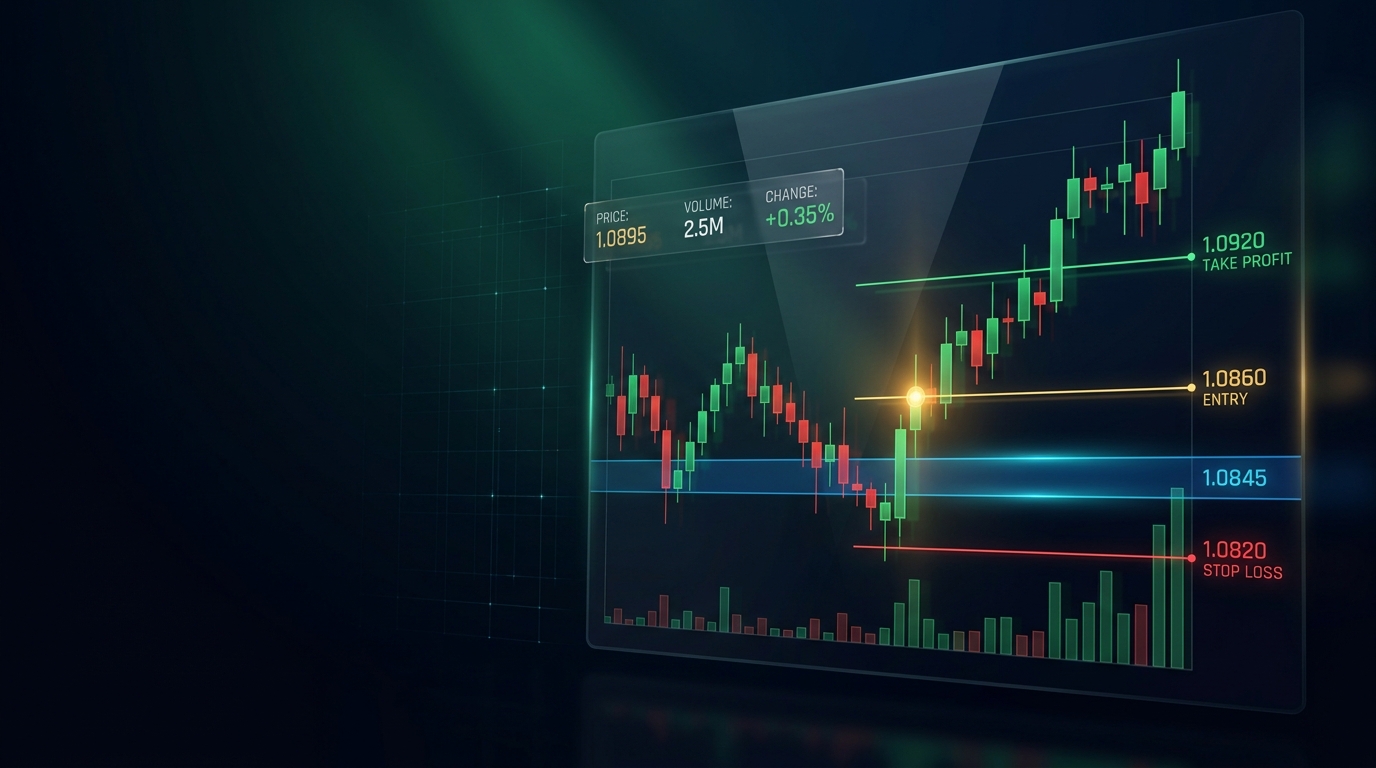
If you’re new to trading, you’ve probably heard people talk about “finding a good entry.” But what does that actually mean? A trading entry point is simply the price at which a trader decides to open a position — to buy or sell an asset. It sounds simple, but choosing the right entry point is one of the most important skills a trader can learn.
In this guide, we’ll break down what an entry point is, why it matters, and the simple tools traders use to find one. This article is for beginners, so we’ll keep things practical and avoid jargon wherever we can.
What Is a Trading Entry Point?
A trading entry point is the exact price level where a trader opens a trade. If you buy a stock at $50, then $50 is your entry point. If you’re shorting a currency pair at a certain level, that level is your entry point too.
Entry points aren’t random. Most traders choose them based on some kind of analysis — usually technical analysis — that tells them a price level looks favorable for starting a trade. A good entry point gives a trader a reasonable chance of the trade moving in their favor, while keeping potential losses manageable.
Why Is an Entry Point Important in Trading?
Your entry point affects almost everything else about a trade. It determines:
- How much risk you’re taking on
- Where you might place a stop-loss
- What your potential reward looks like compared to your risk
Two traders can look at the exact same asset and end up with very different results, simply because they entered at different prices. This is why traders spend so much time studying charts before pulling the trigger — the entry is where the trade’s risk and reward profile gets set.
What Is a Trading Setup?
A trading setup is the specific combination of conditions that a trader looks for before entering a trade. Think of it as a checklist. A setup might include things like: price reaching a certain support level, a candlestick pattern forming, and an indicator confirming momentum.
When all the pieces of a setup line up, a trader considers that a signal worth acting on. Without a defined setup, entries tend to become guesswork.
How Do Traders Find Entry Points?
There’s no single “correct” way to find an entry point — different traders use different tools. Here are some of the most common ones beginners should know:
Support and Resistance Support is a price level where an asset has historically stopped falling, and resistance is where it has historically stopped rising. Many traders look for entries near support (for buying) or resistance (for selling), since these levels often act like floors and ceilings for price.
Candlestick Patterns Candlestick charts show the open, high, low, and close of a price over a set period. Certain patterns, like a hammer or an engulfing candle, can hint that momentum is shifting, which some traders use as an entry signal.
Moving Averages A moving average smooths out price data over time to show the general trend. Traders sometimes enter when price crosses above or below a moving average, or when a short-term average crosses a longer-term one.
RSI (Relative Strength Index) RSI measures how fast and how far price has moved recently, on a scale from 0 to 100. It’s often used to spot when an asset might be overbought or oversold, which can hint at a possible entry opportunity.
MACD (Moving Average Convergence Divergence) MACD compares two moving averages to show changes in momentum. When the MACD line crosses its signal line, some traders treat that as a potential entry cue.
Chart Patterns Patterns like triangles, flags, or head-and-shoulders formations can suggest that price is about to break out in a certain direction, giving traders a possible entry zone.
None of these tools guarantees a winning trade on their own. Most experienced traders combine two or three of them to confirm a setup before entering.
Entry Point vs Exit Point: What’s the Difference?
An entry point is where you open a trade. An exit point is where you close it — either to take a profit or to cut a loss. Beginners often focus only on entries, but knowing your exit before you even enter is just as important. A trade without a planned exit can turn a small loss into a much bigger one.
How Technical Analysis Helps With Trade Entries
Technical analysis is the practice of studying price charts and indicators to make trading decisions, rather than relying on news or company fundamentals alone. It gives traders a structured way to read price behavior and time their entries more consistently.
Instead of entering a trade because “it feels right,” technical analysis encourages traders to base decisions on patterns, levels, and indicators that can be checked and repeated. This doesn’t remove risk, but it does add discipline to the process.
How a Trading Plan Can Help You Find Better Entries
A trading plan is a written set of rules that guides how a trader enters and exits trades. It usually includes the setups a trader looks for, the indicators they use, and their rules around risk.
Having a plan matters because it removes a lot of the emotional decision-making that leads to bad entries. Instead of reacting to every price move, a trader with a plan waits for their specific conditions to be met before acting. Over time, this tends to lead to more consistent decision-making than trading on instinct alone.
By the way, if you’re building your trading knowledge from scratch, Bull & Bear Whispers Instagram page regularly shares simple breakdowns of concepts like these — it’s worth a follow if you’re learning.
Common Trading Entry Mistakes Beginners Make
Even with the right tools, beginners often fall into similar traps:
- Entering without a plan — jumping into trades without any defined setup or rules
- Chasing price — entering after a big move has already happened, out of fear of missing out
- Ignoring support and resistance — entering at levels that have little logical basis
- Entering because of FOMO — acting on excitement or panic rather than analysis
- Entering without risk management — not knowing how much you’re risking before you place the trade
Avoiding these mistakes is often more valuable than finding the “perfect” indicator.
Should Traders Enter Every Trading Setup?
No. Not every setup deserves a trade. Even when conditions look promising, experienced traders often skip trades that don’t fully match their plan, or where the risk doesn’t make sense compared to the potential reward. Patience is a real skill in trading — waiting for a genuinely strong setup is usually better than forcing an entry just to stay active in the market.
Final Thoughts
A trading entry point might seem like a small detail, but it shapes the entire outcome of a trade. By learning to combine tools like support and resistance, candlestick patterns, moving averages, RSI, and MACD — and by sticking to a clear trading plan — beginners can move away from guesswork and toward more structured decision-making.
Trading always involves risk, and no method guarantees profits. But understanding how entries work is a solid foundation for anyone starting to learn technical analysis.
For more beginner-friendly trading and finance breakdowns like this one, follow the Bull & Bear Whispers WhatsApp Channel.