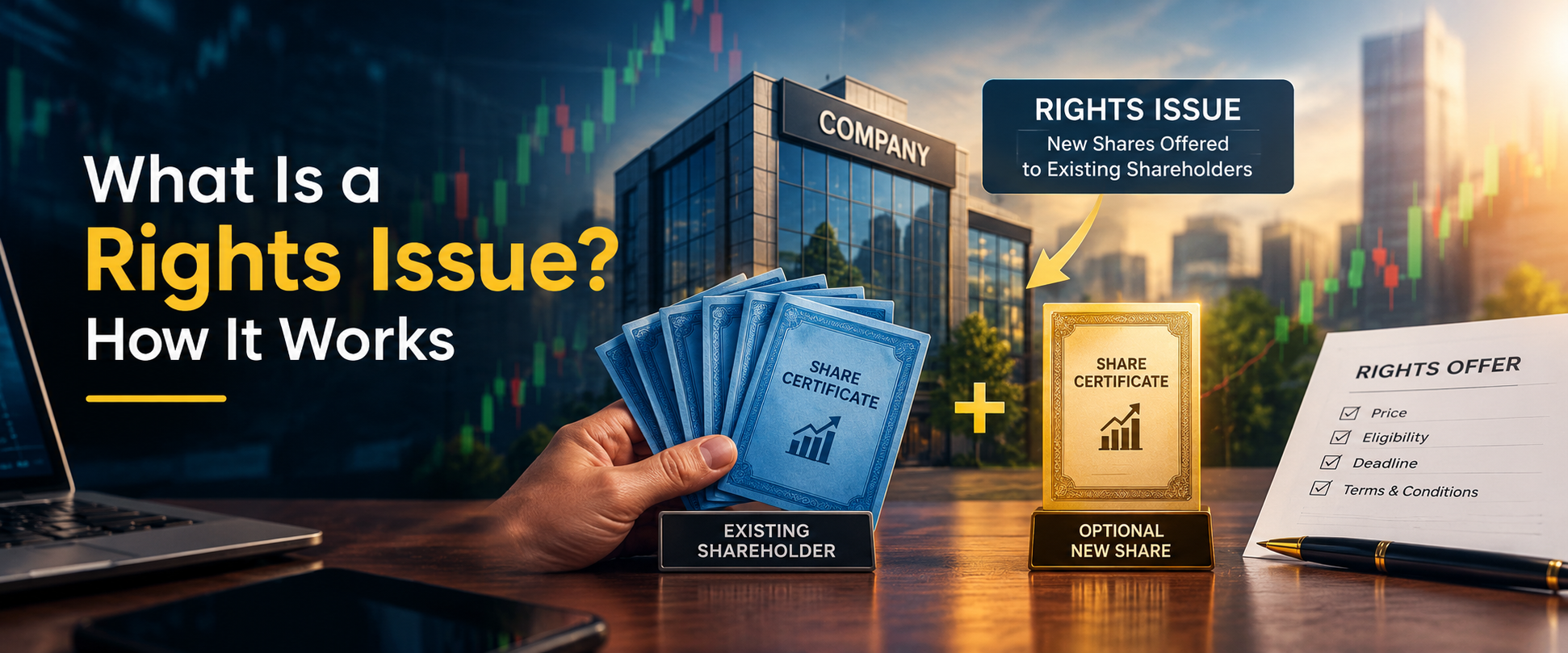
A rights issue is a way for a company to raise money by offering eligible existing shareholders the opportunity to purchase additional shares, usually in proportion to their current holdings.
For example, an offer might allow shareholders to buy one new share for every five they already own. The offer document explains the price, eligibility, deadlines, and other conditions.
Receiving an entitlement is not the same as receiving free shares. Participation generally requires paying the subscription price.
In this Daily Dunia guide, you will learn how the process works, what choices shareholders may have, and how an issue can affect ownership.
What Is a Rights Issue?
A rights issue offers eligible existing shareholders an opportunity to subscribe for newly issued shares.
“Subscribe” means applying and paying for shares under the offer’s terms. The subscription price is the amount payable for each new share.
The offer is generally proportional. Someone with a larger eligible holding receives a correspondingly larger entitlement.
A rights-offer document published through PSX, for example, describes new ordinary shares offered to existing shareholders in proportion to their holdings.
However, rights are not identical across all offers. Eligibility restrictions, transferability, fractional entitlements, and allocation procedures depend on the documents and applicable rules.
Read those conditions rather than assuming every shareholder has the same options in every market.
Why Do Companies Announce Rights Issues?
Companies use rights issues to obtain funding while offering existing shareholders an opportunity to participate.
Possible purposes include:
- Expanding operations or production.
- Financing new projects or technology.
- Repaying debt.
- Supporting working capital—the resources needed for everyday operations.
- Meeting other financial or business requirements.
The reason matters. Funding expansion presents different questions from raising money to address financial pressure.
For a documented Pakistan example, 786 Investments’ offer document identified loan repayment, technology upgrades, and investments among its proposed uses of proceeds. These were that company’s stated plans, not guaranteed outcomes.
A rights issue therefore does not automatically indicate either strength or distress. Examine the company’s financial position and explanation for needing capital.
How Does a Rights Issue Work?
Understanding how a rights issue works starts with its announcement and offer terms.
1. The company announces the proposal
The announcement describes the intended fundraising and relevant corporate decisions. Required approvals and conditions depend on the jurisdiction.
2. The terms and dates are published
The company specifies the ratio, subscription price, eligibility arrangements, application process, and deadlines.
A record date or book-closure arrangement may help determine entitlement. The offer document explains which dates apply.
3. Eligible shareholders review their choices
Shareholders consider the company’s plans, costs, risks, and available options.
4. Instructions and payment are submitted
Participation requires following the stated procedure. A broker or custodian may impose an earlier processing deadline than the offer’s final deadline. A SEC-filed U.S. prospectus expressly highlights this possibility.
5. The offer is completed
Shares are allocated and delivered according to the applicable conditions. Procedures can differ between companies and countries.
A Simple Rights Issue Example
Consider a hypothetical investor who owns 100 shares.
The company announces one new share for every five existing shares. The investor’s potential entitlement is:
100\div5=20\text{ new shares}
If the subscription price is $8, applying for all 20 costs:
20\times\$8=\$160
| Item | Hypothetical figure |
| Existing holding | 100 shares |
| Offer ratio | One new share for every five held |
| Potential entitlement | 20 shares |
| Subscription price | $8 |
| Cost before fees | $160 |
If the application is valid and all 20 shares are allotted, the investor would hold 120 shares.
This example is illustrative, not a real announcement. Eligibility, allocation, fees, and the final number received depend on the actual terms.
Do not assume the subscription price guarantees an immediate profit. A company’s market price can change before the new shares arrive.
What Options Do Shareholders Have?
A rights issue for existing shareholders may offer several choices, but not every choice is available in every issue.
Subscribe for some or all
An eligible shareholder may apply for additional shares within the permitted entitlement.
Some offers also allow applications for extra shares left unsubscribed by others. Allocation under such arrangements is not necessarily guaranteed.
Decline the offer
Shareholders can generally choose not to participate. Existing holdings remain, but proportional ownership may decrease if additional shares are issued.
Unused rights may expire without value, depending on the structure.
Transfer or sell rights where permitted
Some rights are transferable and may trade during a designated period. Others cannot be sold or assigned.
The PSX-published document cited above included a trading period for unpaid rights. By contrast, a SEC-filed rights-offering prospectus describes non-transferable rights with no trading market. These are offer-specific examples, not universal national rules.
Follow Daily Dunia on Instagram for simple trading and finance explainers.
How Can a Rights Issue Affect Shareholders?
The effects involve ownership, funding requirements, and market value.
Ownership percentage
Suppose the hypothetical company initially has 1,000 shares and issues 200 more. Our investor starts with 100 shares, representing 10%.
If the investor does not participate, the unchanged 100 shares represent approximately 8.33% of 1,200 shares.
If the investor receives the full 20-share entitlement, 120 out of 1,200 remains 10%, assuming no other changes.
This illustrates ownership dilution: the same holding can become a smaller percentage. The SEC-filed prospectus warns of this potential effect for non-participating shareholders.
Cash requirements
Maintaining proportional ownership may require additional money. It is not a cost-free adjustment.
Share price
Prices may react to the announcement, funding purpose, and subscription terms.
The ex-rights date generally marks when shares trade without the relevant entitlement. A discounted offer may produce a price adjustment, but actual prices also reflect demand and other information.
Potential business benefits
New funding may support the company, but benefits depend on execution. Neither profit nor loss is guaranteed.
For background on share-price movements, read Daily Dunia’s guide to how trading works.
Rights Issue vs. Public Offering
The rights issue vs public offering distinction mainly concerns whom the offer initially targets.
| Feature | Rights issue | Broader public offering |
| Main audience | Eligible existing shareholders | A wider eligible investor group |
| Allocation basis | Usually linked to existing holdings | Depends on the offering structure |
| Price | Stated subscription terms | Determined under the offering’s pricing process |
| Participation | Requires satisfying the rights offer’s conditions | Requires satisfying the public offer’s conditions |
These categories are not always legally separate. A rights offering itself can be registered as a public securities offering, as the SEC-filed prospectus demonstrates.
An existing-shareholder offer is also not necessarily an IPO. A company can raise additional equity after it is already listed.
How Can Investors Check a Rights Issue?
Begin with official documents rather than a social-media summary.
Review:
- The company’s announcement and offer document.
- Subscription price and entitlement ratio.
- Eligibility and record or book-closure dates.
- Application, payment, and delivery dates.
- Transferability and any rights-trading window.
- Fractional-entitlement treatment.
- The proposed use of proceeds.
- Risks, conditions, and possible changes.
Confirm broker processing deadlines separately. Also check whether an application can be withdrawn; some offers make exercised rights irrevocable.
For Pakistani securities, consult company disclosures through PSX and relevant SECP requirements. For U.S. securities, review filings through the SEC’s EDGAR database.
Use documents for the current offer. An older company’s schedule does not establish today’s deadline or procedure.
Frequently Asked Questions
What is a rights issue in the stock market?
It offers eligible existing shareholders an opportunity to buy new shares, generally in proportion to their holdings.
Why do companies offer rights issues?
Reasons include expansion, debt repayment, working capital, and other funding needs. The company should explain its intended use of funds.
Can shareholders refuse a rights issue?
Generally, yes. Participation is optional, but unused rights may expire and proportional ownership may decrease.
Does a rights issue reduce the share price?
It can affect the price, particularly around entitlement changes. However, the direction and size of market movements are not guaranteed.
What happens if a shareholder does not participate?
They generally retain their existing shares, but may own a smaller percentage after the new issuance. Transfer or sale alternatives depend on the terms.
Conclusion
A rights issue raises funds by offering eligible existing shareholders additional shares under specified conditions.
Its impact depends on the terms, participation, and use of proceeds. Review the official documents before deciding what to do.
Explore more beginner-friendly finance guides on Daily Dunia, and join the Daily Dunia WhatsApp Channel for educational articles and updates.