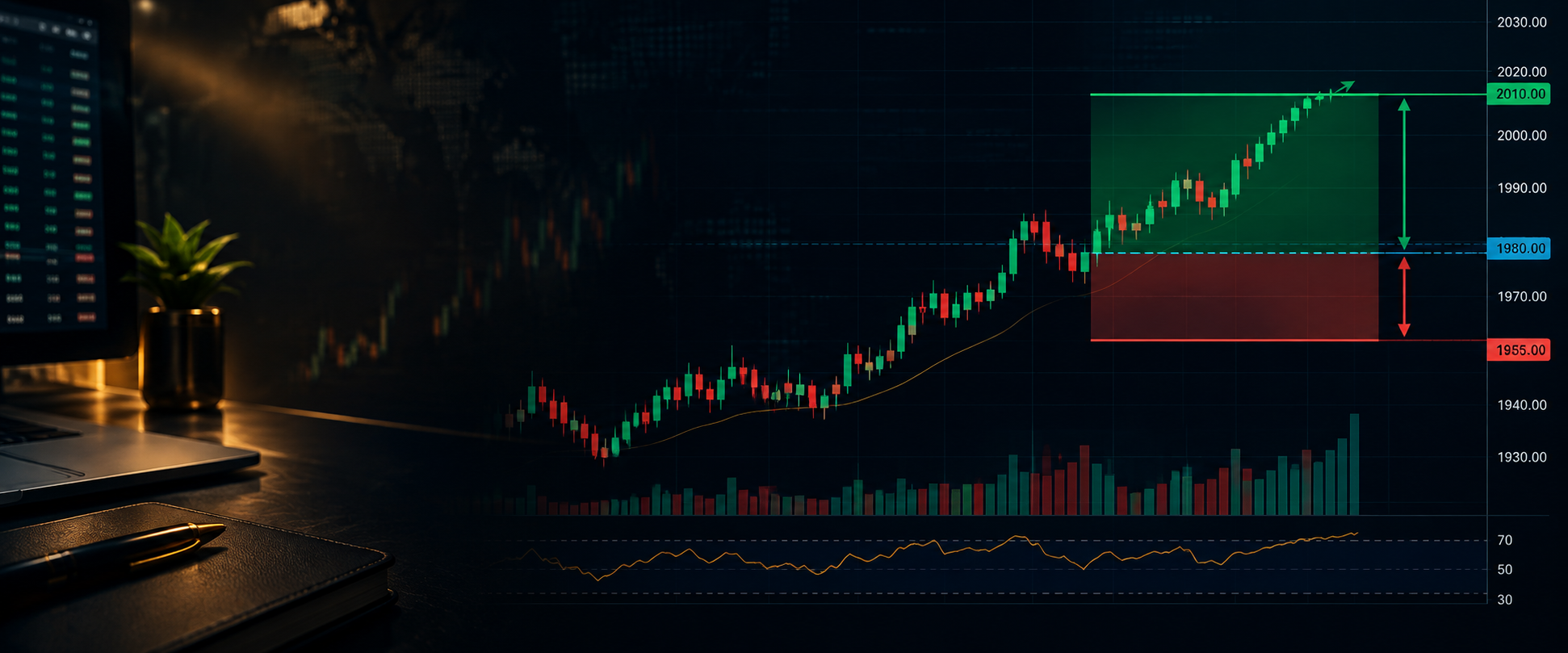
Every trade has two sides: what you could lose, and what you could gain. The risk reward ratio in trading is simply a way of comparing these two numbers before you enter a position. It doesn’t predict whether a trade will win or lose. It just tells you whether the trade is worth taking, based on how much you’re risking compared to how much you could earn.
At Daily Dunia, we get a lot of questions from new traders who focus only on potential profit and forget to measure the risk side of the equation. This article breaks down the risk-reward ratio in plain language, with real examples you can apply to your own trade setups.
What Is the Risk-Reward Ratio in Trading?
The risk reward ratio compares the amount of money you could lose on a trade to the amount you could gain. It’s written as a ratio, like 1:2 or 1:3.
If your ratio is 1:2, it means you’re risking one unit of money to potentially make two units. If it’s 1:3, you’re risking one unit to potentially make three.
This ratio is calculated before you place a trade, using your planned entry price, stop-loss level, and take-profit level. It’s a planning tool, not a guarantee.
Why Does Risk-Reward Ratio Matter in Trading?
Trading risk reward matters because it forces you to think about losses before you think about profits. Many new traders jump into a trade because they’re excited about a potential gain, without asking a simple question: how much am I willing to lose if this doesn’t work out?
By calculating the ratio in advance, a trader can:
- Decide if a trade setup is worth the risk
- Compare different trade opportunities against each other
- Set realistic stop-loss and take-profit levels
- Avoid entering trades where the potential loss outweighs the potential gain
This is one of the core building blocks of trading risk management, and it works alongside other tools like position sizing and stop-loss placement.
How to Calculate Risk-Reward Ratio
The risk reward ratio formula is straightforward:
Risk = Entry Price − Stop-Loss Price Reward = Take-Profit Price − Entry Price Risk-Reward Ratio = Risk ÷ Reward
Here’s a simple numerical example. Suppose you buy a stock at $50. You set your stop-loss at $48 and your take-profit at $54.
- Risk = $50 − $48 = $2
- Reward = $54 − $50 = $4
- Ratio = $2 : $4, which simplifies to 1:2
That means for every $1 you’re risking, you’re aiming to make $2.
What Does a 1:2 Risk-Reward Ratio Mean?
Different ratios represent different balances between risk and potential reward.
1:1 Ratio You’re risking the same amount you could gain. If you risk $10, you’re aiming to make $10.
1:2 Ratio You’re risking half of what you could potentially gain. Risk $10 to potentially make $20. A 1:2 risk-reward ratio is one of the most commonly discussed setups in risk reward trading strategy because it allows a trader to be profitable even with a lower win rate.
1:3 Ratio You’re risking a smaller portion of the potential reward. Risk $10 to potentially make $30. This requires more room for the trade to develop, which usually means a wider stop-loss and a longer wait for the take-profit target.
None of these ratios is automatically “correct.” The right ratio depends on the strategy, the market, and the trader’s own plan.
Risk-Reward Ratio Example
Let’s walk through a full trade setup.
Imagine a trader is watching a stock currently trading at $100. Based on their analysis, they decide:
- Entry price: $100
- Stop-loss: $97 (a $3 risk)
- Take-profit: $109 (a $9 potential reward)
Risk-reward ratio = $3 : $9 = 1:3
This means the trader is risking $3 per share to potentially gain $9 per share. Whether this trade actually hits the take-profit or the stop-loss depends on market movement the ratio only describes the plan, not the outcome.
Risk-Reward Ratio vs Win Rate
This is where many traders get confused. A good risk-reward ratio does not automatically mean a profitable trading strategy. Win rate the percentage of trades that end in profit matters just as much.
Here’s why: a trader with a 1:3 risk-reward ratio only needs to win about 25–30% of their trades to break even or turn a profit, assuming consistent position sizing. But if their actual win rate is much lower than that, even a strong ratio won’t save the strategy.
On the other hand, a trader using a 1:1 ratio might need to win more than half their trades to stay profitable, but if their strategy has a genuinely high win rate, that can still work.
The key takeaway: risk-reward ratio and win rate are two separate numbers, and both have to be considered together. A high ratio with a very low win rate can still lose money overall.
How Stop Loss and Take Profit Affect Risk-Reward
Your stop loss and take profit levels directly control your ratio. Move either one, and the ratio changes.
- Tightening the stop-loss (moving it closer to entry) reduces your risk amount, which can increase your ratio but it also increases the chance of getting stopped out by normal price movement.
- Widening the stop-loss gives the trade more room to breathe, but increases the risk amount and lowers the ratio unless the take-profit is adjusted too.
- Raising the take-profit target increases potential reward and improves the ratio, but a target set too far from realistic price action may rarely get hit.
This is why stop loss and take profit levels shouldn’t be picked just to create a “nice-looking” ratio. They should reflect actual market structure support levels, resistance levels, and volatility.
How Traders Use Risk-Reward in a Trading Plan
Risk to reward ratio planning doesn’t work in isolation. It’s one part of a complete trading plan, alongside entry point selection, position sizing, and overall risk management rules.
A typical process looks like this: a trader identifies a trade setup, marks a logical stop-loss based on market structure (not a random number), sets a realistic take-profit based on resistance or support levels, and only then calculates the resulting risk-reward ratio. If the ratio doesn’t meet their minimum standard, say, at least 1:2 they may decide to skip the trade entirely.
This process keeps decisions consistent and removes a lot of the guesswork and emotion from trading.
Common Risk-Reward Mistakes Traders Make
Even experienced traders fall into these traps:
- Choosing unrealistic profit targets just to make the ratio look better on paper, without checking if the price is likely to reach that level
- Placing a very tight stop loss purely to boost the ratio, which often results in getting stopped out too early by normal price fluctuation
- Ignoring market structure and picking stop-loss or take-profit levels at random, round numbers instead of logical price zones
- Changing the ratio mid-trade because of emotions moving a stop-loss further away after a trade starts moving against them, hoping it will recover
- Focusing only on potential profit and skipping the risk calculation altogether
Avoiding these mistakes is often more valuable than chasing a “perfect” ratio.
Is a Higher Risk-Reward Ratio Always Better?
Not necessarily. A higher ratio, like 1:4 or 1:5, sounds appealing, but it usually requires a wider price move to hit the take-profit target, which can mean the trade takes longer to play out or hits the stop-loss more often before reaching that target.
A lower ratio, like 1:1, might actually suit a strategy with a genuinely high win rate better than forcing a higher ratio that doesn’t match how the market is actually behaving.
There’s no universal “best” ratio. What matters more is consistency using a ratio that fits your strategy’s real win rate, market conditions, and risk tolerance, and sticking to it across many trades rather than changing it trade by trade.
If you want to go deeper into the mechanics of position sizing and how it pairs with risk-reward, look up What Is Position Sizing in Trading? The two concepts work closely together. It’s also worth reviewing What Is a Trading Entry Point? since your entry price is the starting point for every risk-reward calculation. For a broader view of how these pieces fit into a full plan, see How to Build a Trading Plan.
Daily Dunia also shares quick visual breakdowns of concepts like this on our Bull & Bear Whispers Instagram. It’s a useful way to see real trade setups explained in a simple format.
Final Thoughts
The risk reward ratio in trading is a simple but powerful planning tool. It compares what you’re risking to what you could gain, using your entry price, stop-loss, and take-profit levels. A 1:2 or 1:3 ratio is common among traders, but no single ratio guarantees success; it always has to be considered alongside your actual win rate and a solid trading plan.
Before you place your next trade, take a moment to calculate the ratio. Check your stop loss and take profit levels against real market structure, not just round numbers. And remember — good risk management, including tools like What Is Risk Management in Trading?, What Is a Stop Loss in Trading?, and What Is Take Profit in Trading?, matters just as much as the ratio itself.
For more educational reading on risk-reward concepts, Investopedia’s guide on the risk/reward ratio is a solid starting point.
Want more trading and finance breakdowns like this? Follow the Bull & Bear Whispers WhatsApp Channel to get new articles as soon as they’re published.